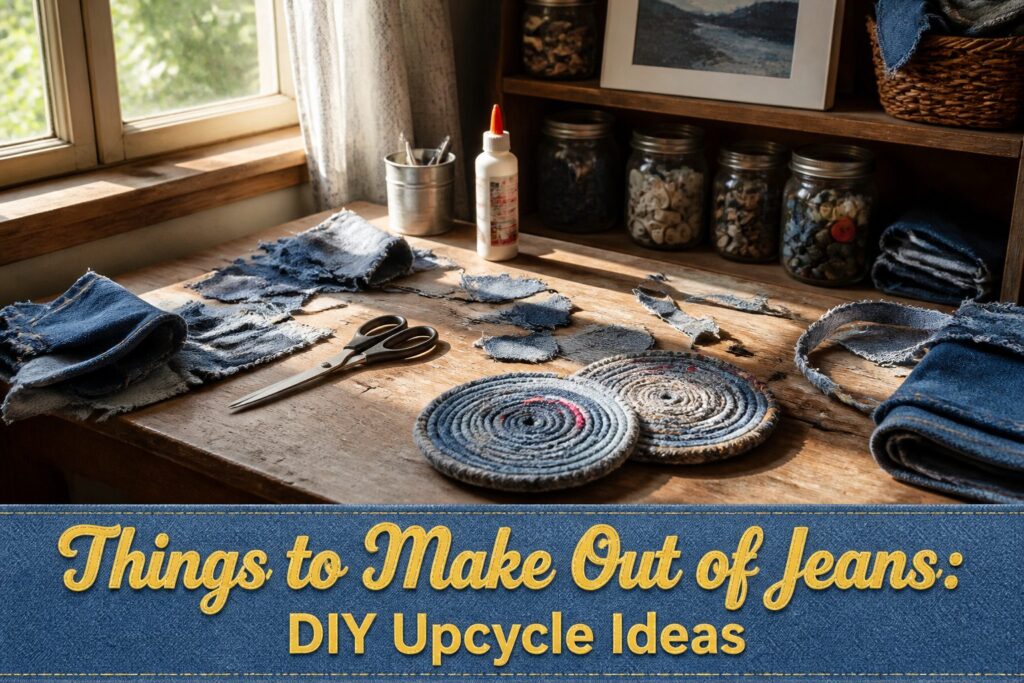
The projects run from a no-sew keychain to a quilt one maker spent 5 years on, and the deciding factor is whether you own a sewing machine.
Glue and scissors cover baskets, coasters and wreaths. Anything sewn needs a denim needle, because thick seams make a regular one skip or snap.
1. Denim Clutch Purse
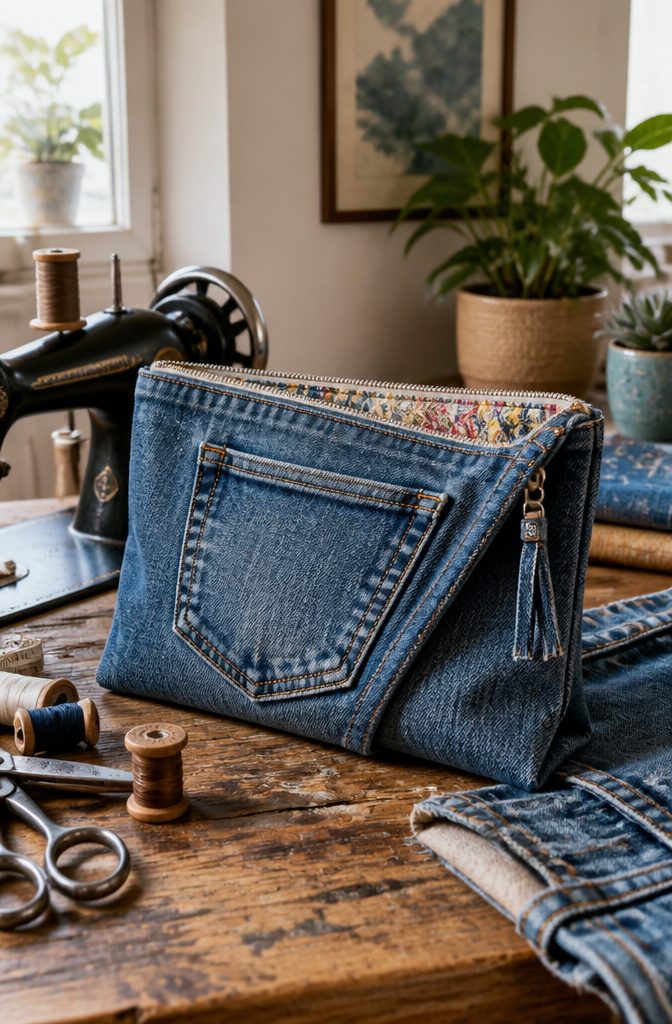
A leg of old jeans makes the easiest clutch I know of, and the seat works too if you want a wider panel. Cut the leg open at one of its seams, then cut two 16″ x 7″ rectangles from the denim.
If you want a lining, cut two more rectangles the same size. A stretchy knit lining needs fusible interfacing; a strong cotton does not.
Switch to a denim needle before you sew, because the seams are thick and a regular needle will skip or snap.
A pocket left on the front of the clutch gives you a ready-made outer pocket, and a bold print inside makes it look planned.
This suits a beginner with a sewing machine: two rectangles, a few straight seams, and a clasp if you want one.
2. Denim Tote Bag
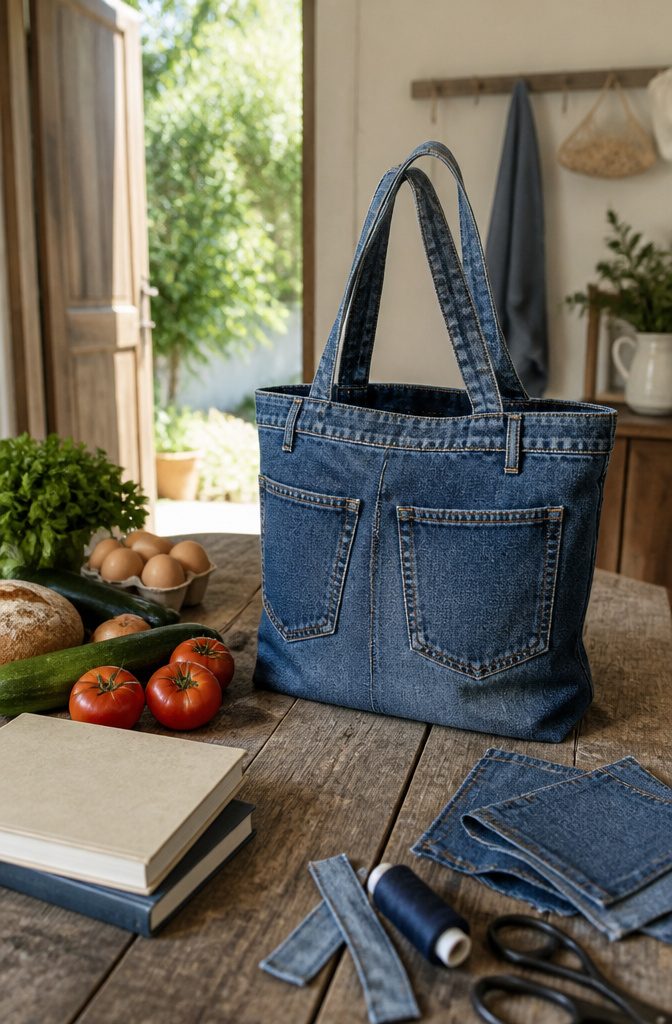
Old jeans already carry the parts that make a tote look finished. The waistband works as a ready-made top edge, and the back pockets become outside pockets with no extra sewing.
Cut the legs off and sew across the bottom to form the body, then use the waistband as the opening.
The leg fabric can become the straps. A pair of jeans is all the fabric you need, plus standard sewing supplies, though a lining is optional if you want a cleaner inside.
Denim is the reason this one holds up.
It resists sagging under a load of groceries or books, and the seams already in the jeans can stay right where they are, which saves you work. A tote this clean won’t scream "made from old pants."
3. Denim Apron
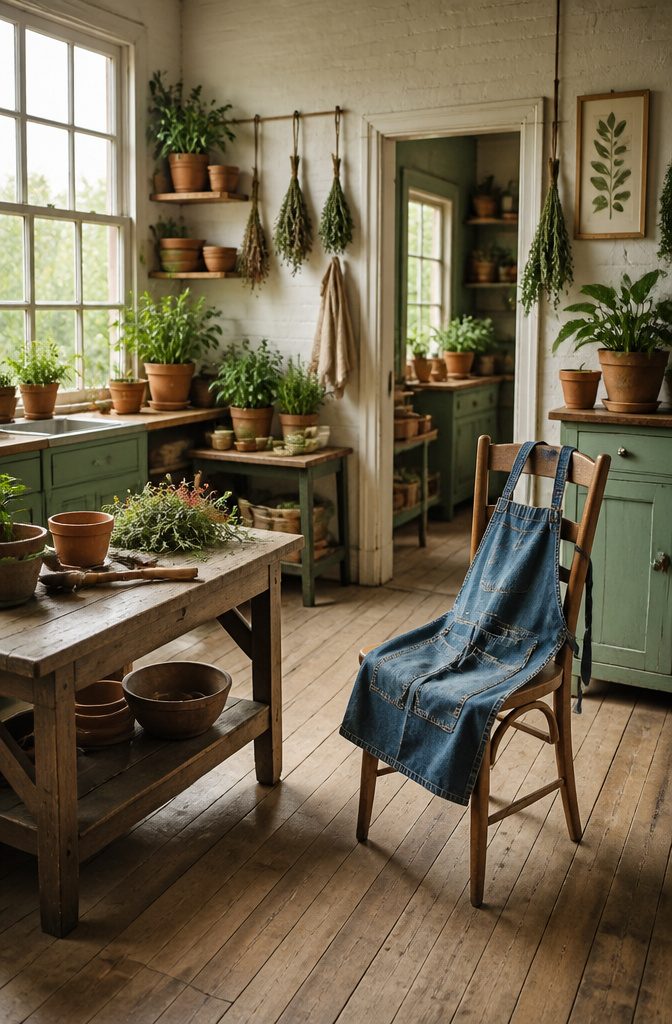
Cut the legs off straight across and make sure the crotch seam goes with them, or the apron will not hang flat.
One tutorial measures 7 1/2″ plus a 5/8″ seam allowance down from the top of the waistband, which leaves room to cut around the back pockets and keep them.
Cutting is the only real work here. It is two straight lines with fabric scissors, so I’d call this a beginner project, though finishing the raw edges and adding neck and waist ties takes some sewing.
Worn-out knees are no problem, since the legs are the part you discard.
The existing pockets are already stitched and reinforced, so they hold pliers, a trowel or a wooden spoon without any extra work. Denim also stands up well to outdoor use, which suits a gardening or craft apron.
4. Denim Basket
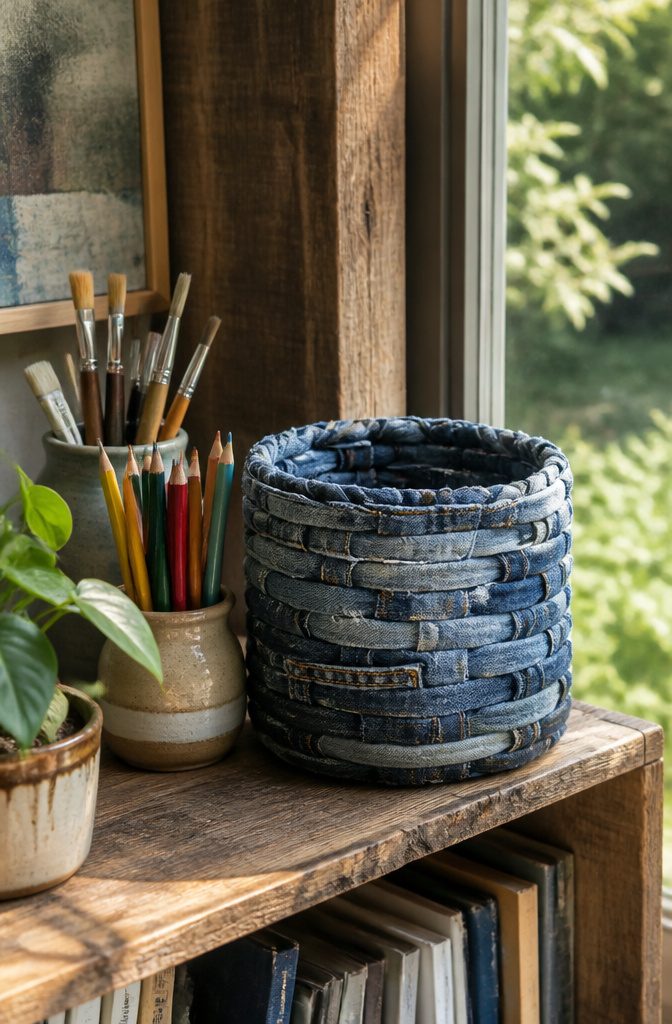
A denim basket is the easiest way into jeans upcycling because it needs no sewing machine, only scissors, fabric glue, and an old pair of jeans.
You cut the denim into strips, then wrap and glue them around a form until the form disappears.
That makes it a good first project for beginners, and kids can handle the wrapping and gluing while an adult does the cutting.
Choose a sturdy base, since the strips only add a skin and the form carries the weight.
Fabric glue is the right adhesive here, because it grips denim fibers and stays flexible once dry. Work in small sections so the glue doesn’t set before the strip is pressed down.
The finished basket looks right on a shelf or desk, holding pens, remotes, or craft scraps. I’d keep it to light storage and skip anything heavy.
5. Denim Pillow
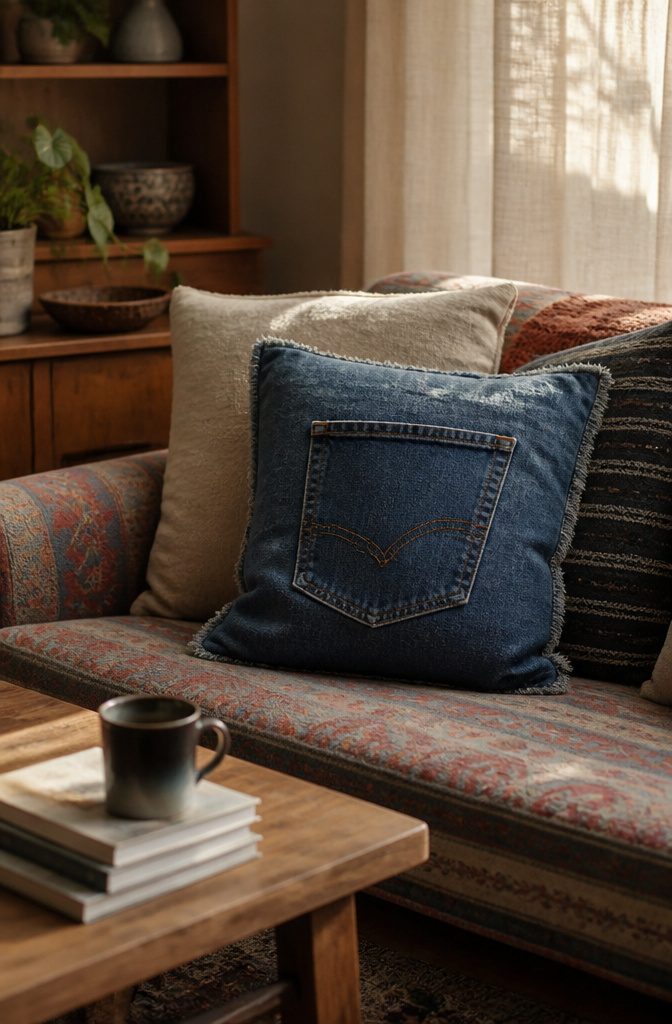
The back pockets are the reason to pick jeans over any other fabric for a pillow.
Cut the leg panels so one pocket sits near the center of the front, and you get built-in storage for a remote or a phone with no extra work.
Cut two squares from the straight part of a leg, one with the pocket and one plain. Place them right sides together and sew three sides with plain straight seams, leaving the fourth open.
Turn it right side out and slide in a pillow form, then stitch the opening shut by hand. Leave the pocket stitching and faded seam lines showing, since they give the pillow its character.
I’d make a cover over a stuffed pillow. A cover lets you wash the denim and swap the insert later.
6. Denim Rug
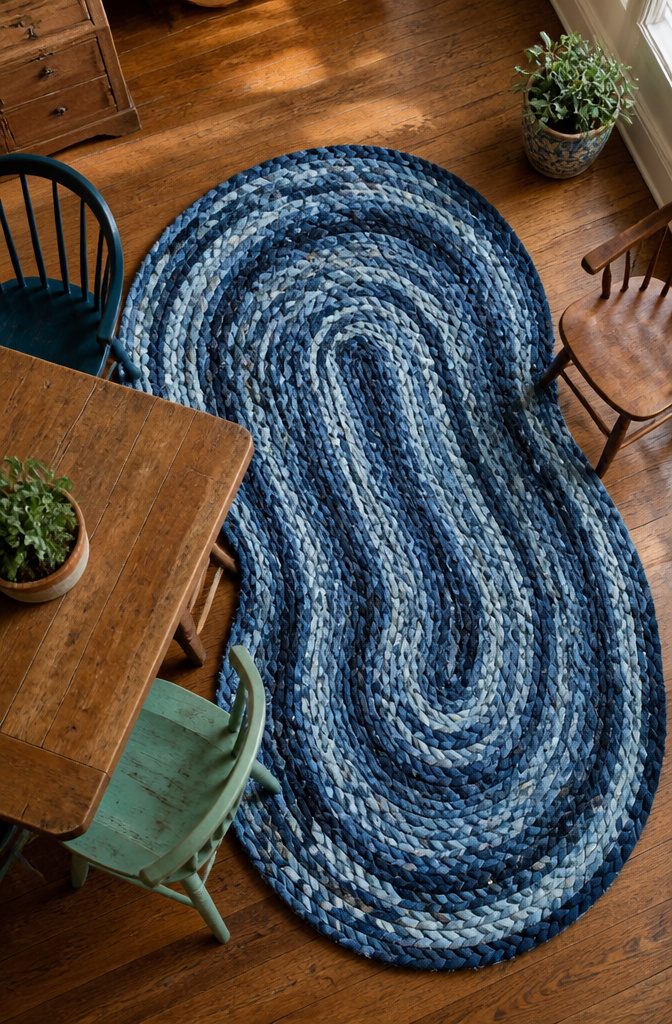
Denim is already a heavy twill, so a rug made from it takes foot traffic, dragging boots and kitchen spills better than most thrifted or store-bought mats.
Cut old jeans into strips, then either sew them together side by side, almost like a quilt, or braid them into long ropes and coil them.
Sewing gives a flat, even surface. Braiding looks more textural and handmade.
Mix light, dark and in-between washes for the look.
Plan on a weekend for a full-size rug, since a big pile of jeans goes fast once the cutting starts. I’d put it in an entryway, kitchen or bathroom, where the toughness pays off.
7. Denim Keychain
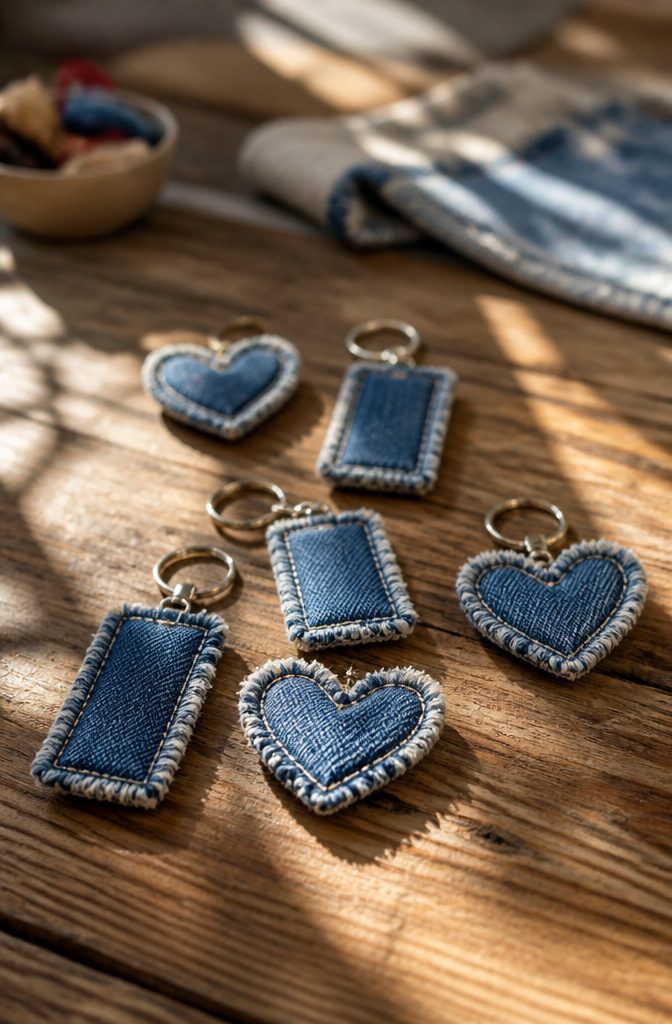
A raggy edge is what makes a denim keychain look finished: you leave the cut edges unhemmed so they fray into a soft fringe.
That also makes it the easiest project in this lineup, since there is no hem to turn and no seam to fight through thick fabric.
Cut two matching scraps from a leg or the back of a pocket, and keep them as small as a heart or a rectangle.
Stack them, stitch around the shape close to the edge, and loop a key ring through a tab at the top. Use the flattest part of the jeans, away from the seams, so the needle doesn’t stall.
It works as a bag charm too, and it’s a gift that gets used every day.
8. Denim Quilt
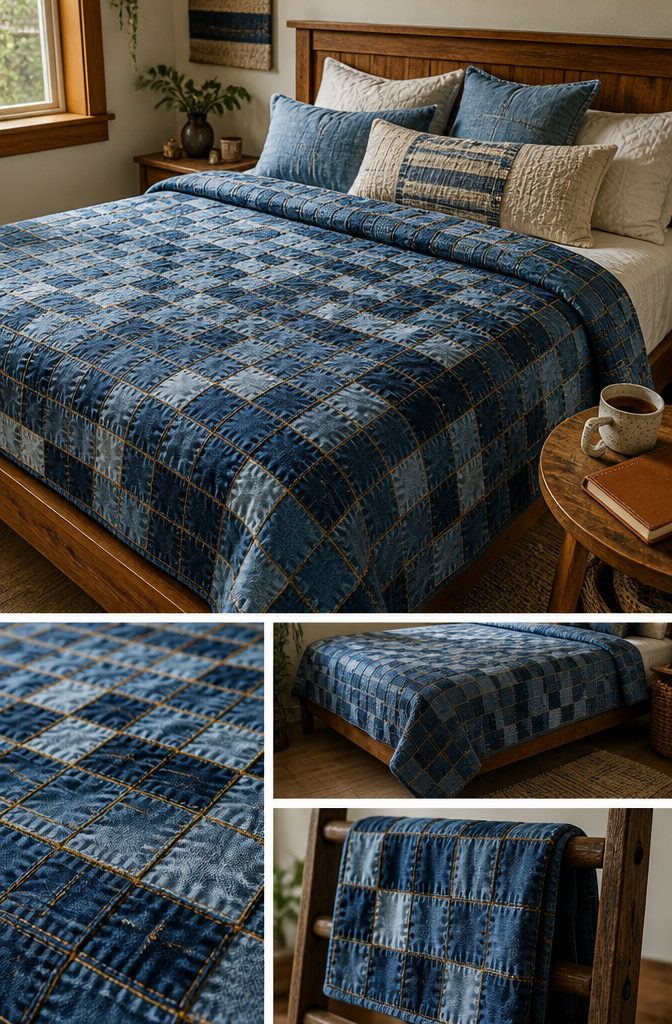
Yes, jeans work for quilting, as long as you cut them into patches first. Denim is heavy for a quilt, so a hundred small pieces will behave better under your needle than a few big panels.
One reference point is a diamond quilt built from 3.5" diamonds with a 3/8" seam allowance.
The maker spent 5 years on it, which tells you the pace: this is a slow project, not an afternoon one. Cut the seams out of the legs and use the flat sections only.
Heavy gold-colored thread, topstitched the way jeans are finished, makes the seams look intentional.
The idea echoes the boro tradition, where worn cloth gets patched and stitched until it becomes something new. I’d pick that look over hiding the stitching.
9. Denim Pocket Organizer
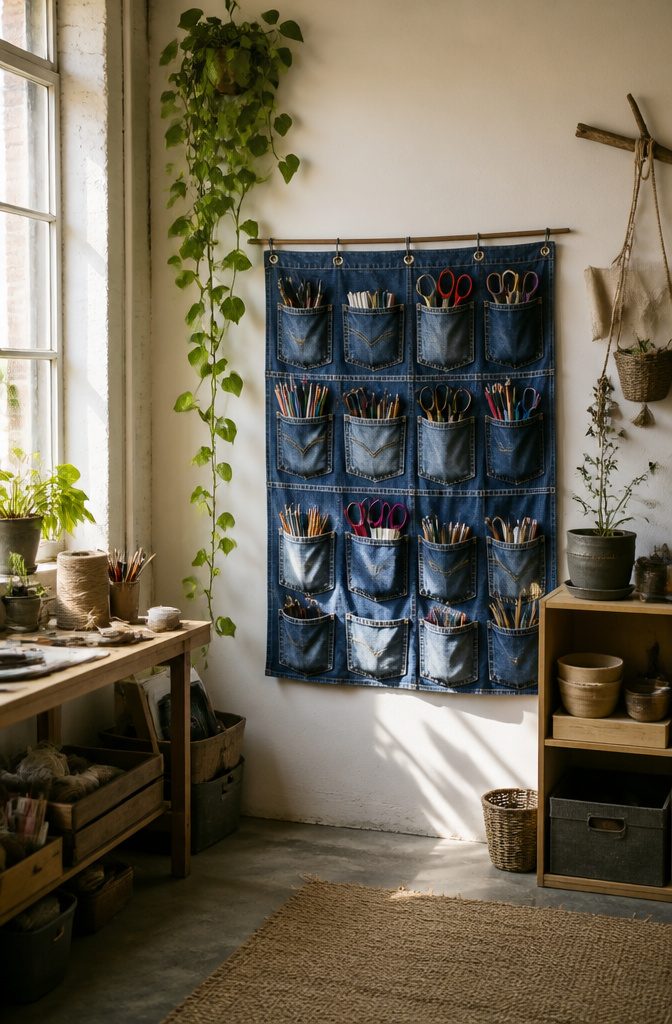
Jeans already come with four or five pockets, and the sewn construction is the hard part of any organizer, so the best version of this project skips new pockets entirely.
Cut each pocket out with a margin of denim around it, leaving the stitching intact. Then sew or glue the pieces onto a backing, such as a fabric panel or a board, in rows.
The backing decides what it can hold.
A fabric panel suits remotes, pens and scissors on a door or wall. For craft supplies like paint brushes or glue sticks, mount the pockets on a rigid board so they don’t sag.
I’d mix back pockets and a coin pocket for varied sizes. Add a loop at the top and it hangs from a single nail or hook.
10. Denim Snack Bag
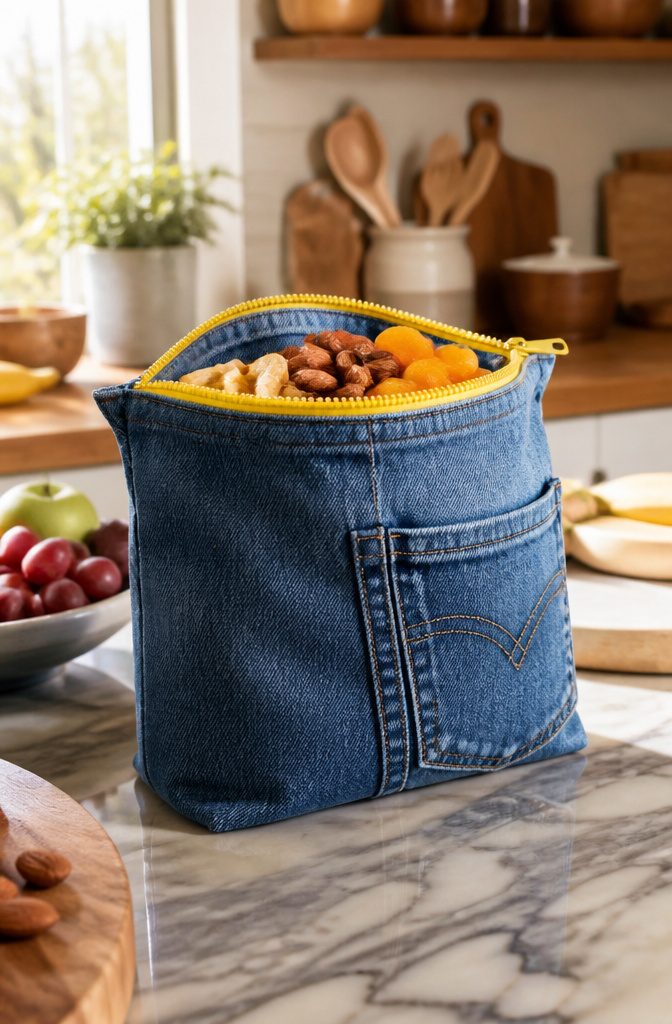
A zipper gives a denim snack bag its store-bought look, and it makes the bag sturdy enough for makeup, cables or craft supplies.
For snacks, I’d still choose the zipper over a flap or tie, because crackers and trail mix stay put when the bag gets tossed into a tote.
A lining is the other decision. Denim alone works fine for small items, but a lining of tightly woven cotton hides the raw seams and wipes clean after a granola bar crumbles.
A magnet snap is the second closure option, and it suits a bigger, tote-style bag better than a small pouch, where a zipper holds up better under daily use.
Cut the bag from the sturdiest part of the leg, where the fabric is flattest and has no worn spots.
11. Denim Jewelry
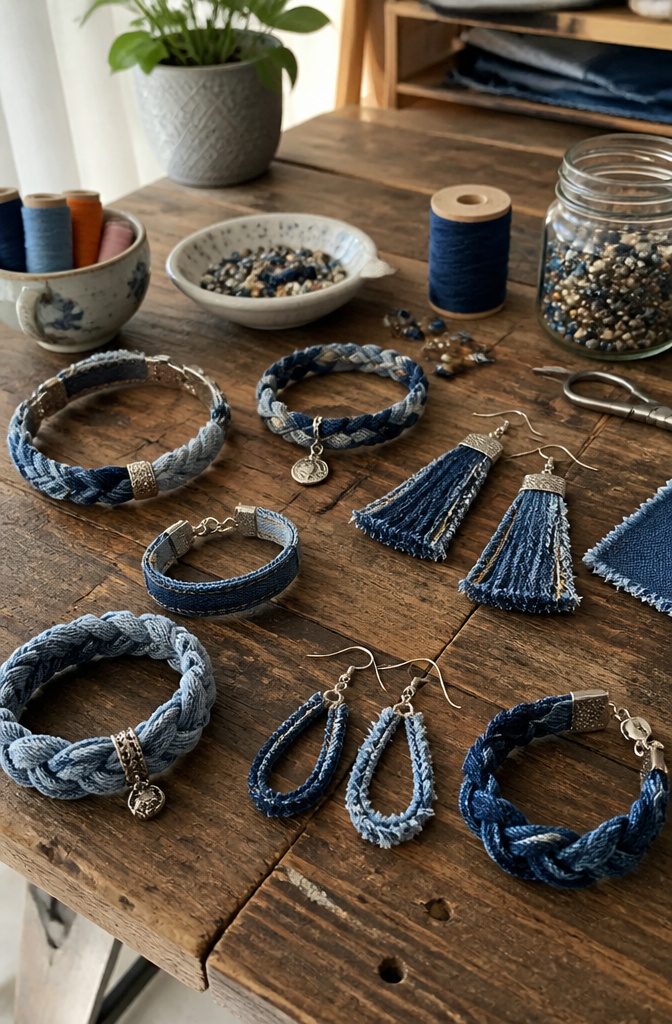
Scraps too small for anything else are the right size for jewelry, and the seam allowances and pocket corners you’d normally toss work best.
Bracelets are the easier start: cut three strips of denim, knot them at one end, braid them, and finish with a snap or a tied knot. Wrap a braid around a cuff base if you want something wider.
Earrings need even less fabric. Cut small circles, squares or teardrops, layer two or three, and glue them to posts or hooks with fabric glue.
Leave the cut edges raw so they fray, and a few washes will soften them into a fuzzy, worn look. I’d keep this one for teens and adults, since small pieces and earring hardware are not for young kids.
12. Denim Dog Toys
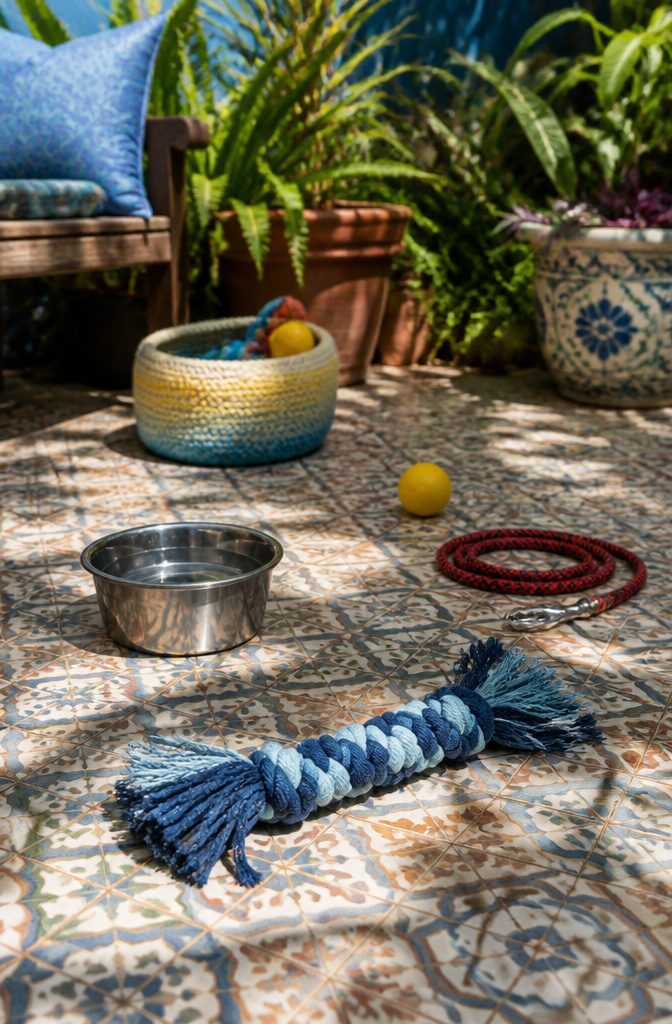
Denim holds up to tugging better than most fabric scraps, which is why old jeans make a good dog toy.
Cut the legs into strips about 2 inches wide, braid three strips together, and knot both ends tight. Strips cut along the grain fray less than ones cut on a slant, and a little fraying is fine.
Skip the thin, worn knees and use the sturdy lower legs and seams. Check the toy before every play session and throw it out once strands loosen or pull apart, because swallowed threads can cause real trouble for a dog.
I would also remove rivets, buttons and zipper pulls before cutting. Stay in the room during tug games, and keep the toy put away when you can’t watch.
13. Denim Wall Decor
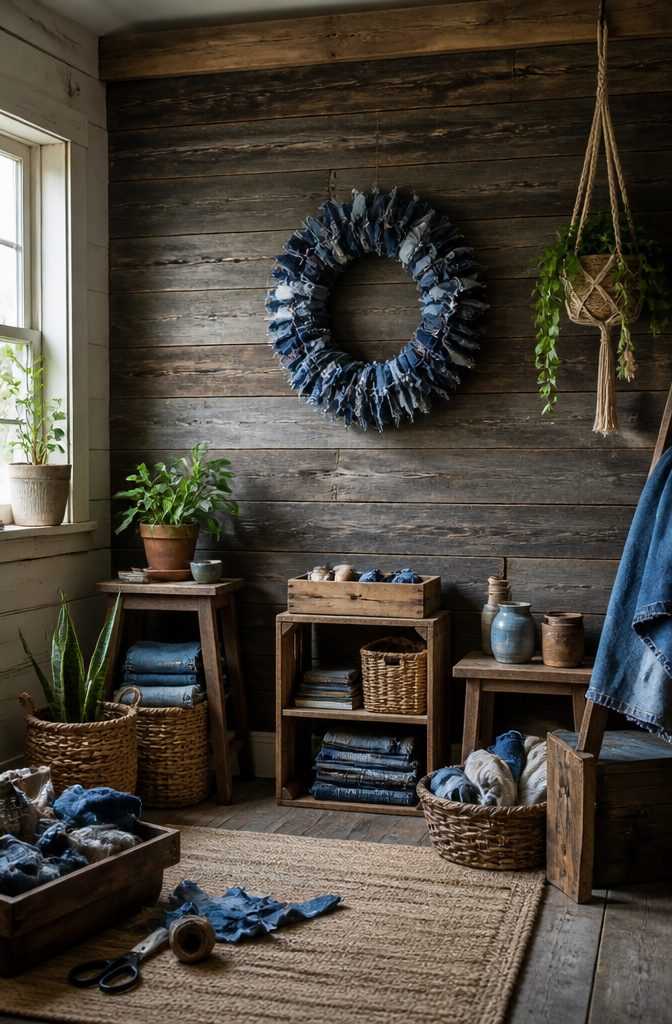
Denim feathers and scrap wreaths are the two wall pieces that use up the smallest leftovers, the bits too short for a bag or a pillow.
For the feathers, cut feather shapes from old denim and layer them into a hanging. No sewing is needed, and the natural texture of the fabric does the decorating for you.
The wreath is even more forgiving. Tie strips of denim around a wreath form until the form disappears, and you get a casual, textured ring that works on a wall all year.
Strips can be uneven and mismatched. I’d choose the wreath if your scrap pile is mostly slivers, since a feather needs a piece with at least some shape to it.
14. Denim Coasters
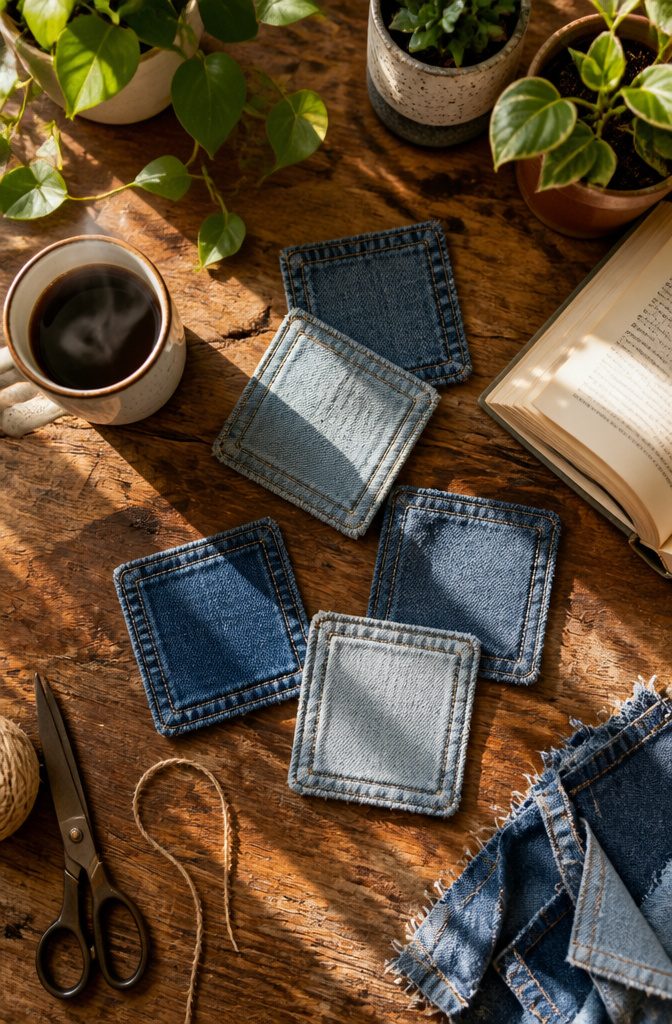
Hems are the best part of a pair of jeans for coasters. The old stitched edge already gives you a sturdy strip, and the hems from one pair are enough to make a set.
Any other part of the leg works too, and a faded knee or a seam running through the middle just adds personality.
For a no-sew version, cut circles or squares from the denim, stack two or three layers, and glue them together.
Kids can handle the gluing and stacking, and the only adult job is the cutting. Cut every piece from the same template so the layers line up and the edges stay even.
I’d choose squares if small hands are doing the cutting, since straight lines are forgiving. Once you’ve made one, you’ll probably keep going and end up with a dozen.
15. Denim Christmas Decorations
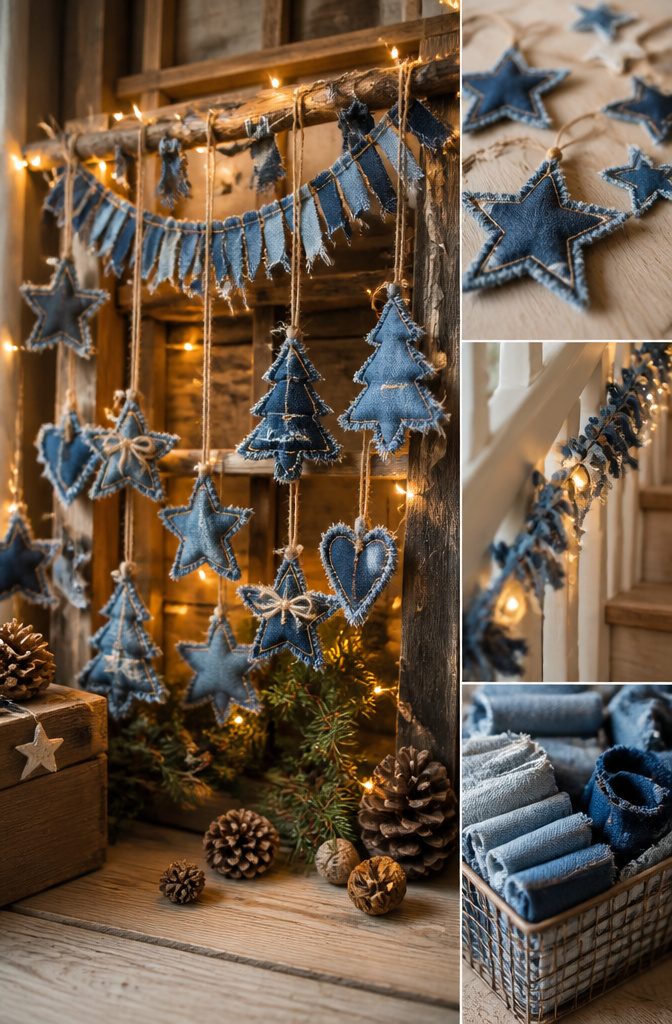
Denim ornaments are a good use for the seams, belt loops and scraps that are too small for anything else.
Belt loops can become small medallions, and the thick seams from the legs can be shaped into simple hanging ornaments. Scrap denim also works for stars, angels and tartan-style trees if you’re willing to sew a little.
For a no-sew version, I’d go with garlands.
Tear or cut scraps into strips and knot them onto a length of twine, the same way a denim scrap wreath is tied around a form. Frayed edges are a feature here, so don’t bother hemming anything.
A family afternoon fits this well.
One person cuts strips, kids tie the knots, and anyone with a needle sews a few stars. Set out a pile of old jeans, and you’ll have a garland by dinner.
Sewing Tips for Thick Denim
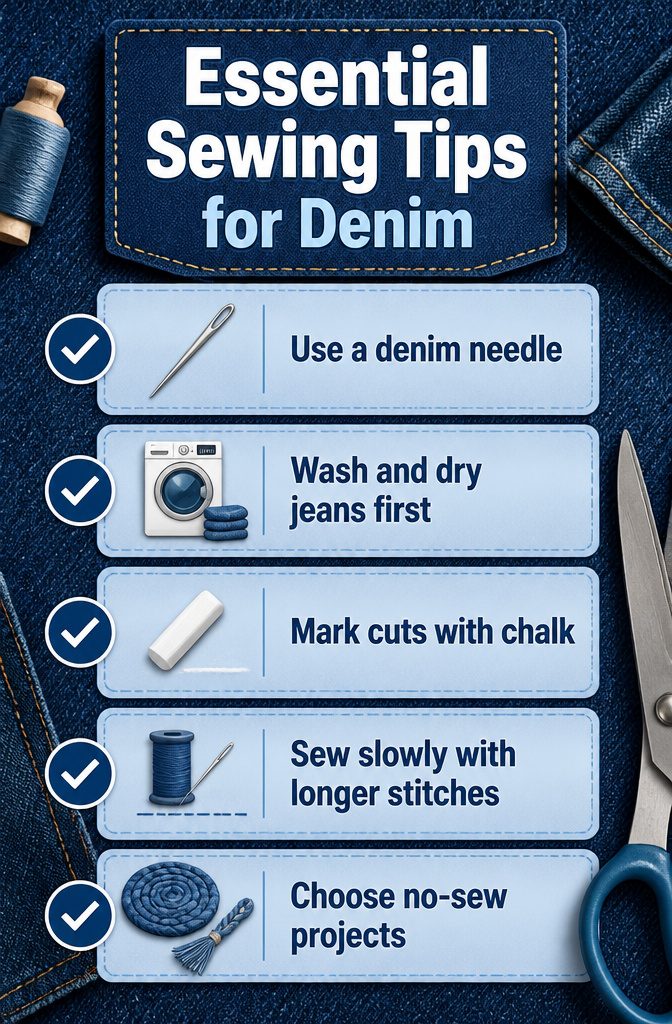
Thick seams are where most jeans projects go wrong, so a few habits matter before the first stitch:
- Use a denim needle (sometimes labeled "jeans" needle). Its sturdy shaft and sharp point push through layered cotton twill without skipping stitches or snapping.
- Wash and dry the jeans first, then cut off the hems, waistband and thick seams. Flat panels from the legs are the easiest fabric to sew.
- Mark cuts with chalk or a washable pen, and cut with sharp fabric scissors. Dull blades chew denim and leave ragged edges.
- Sew slowly and use a longer stitch. Where seams stack up, turn the hand wheel by hand to get over the bump.
- Choose no-sew projects if you’re starting out: coasters, wall hangings and braided pieces can be glued, tied or woven.
Materials and Skill Levels
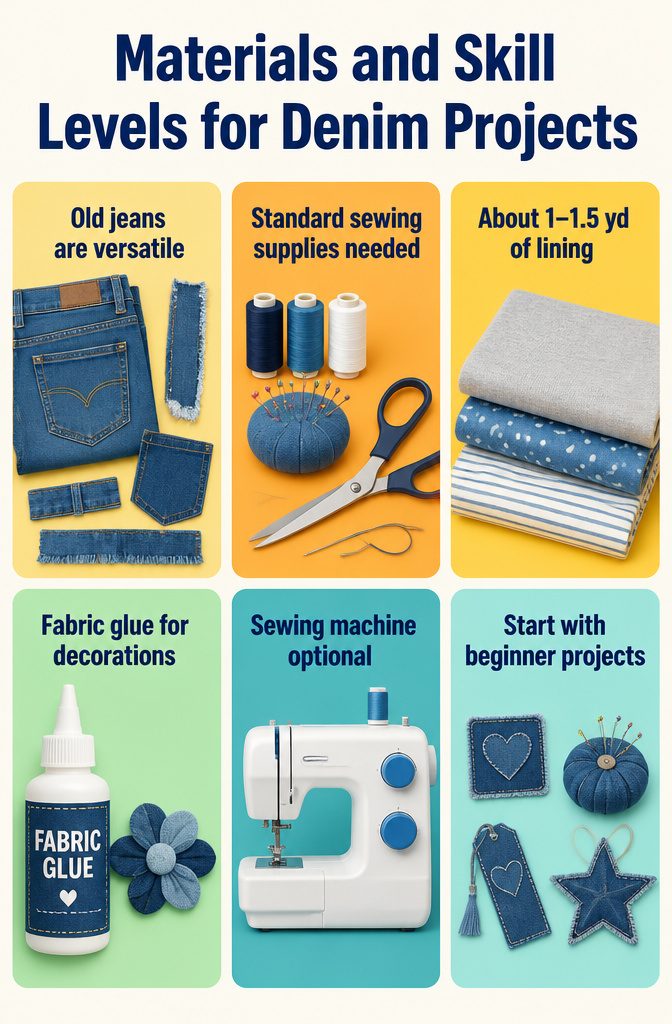
Most of these projects need only what’s already in a sewing drawer. Here is what to gather, then how I’d sort the projects.
- Old jeans: Legs, waistbands, seams, pockets and hems all get used, so keep every scrap.
- Standard sewing supplies: Needle, thread and scissors cover most of the list.
- Lining fabric: About 1–1 1/2 yd of knit or cotton is enough for a skirt and its matching extras.
- Fabric glue: A good stand-in for stitching on small decorations.
- Sewing machine: Only some projects need one; the bags and larger pieces go faster with it.
- Beginner: Coasters, pincushions, bookmarks and ornaments. Many denim upcycles suit all ages and abilities, so kids can handle these with glue and an adult cutting.
- Intermediate: Cross body bags, aprons and pot holders. The bag takes only beginner sewing skills.
- Advanced: Baskets and rugs, which want a machine and patience.
Why Upcycle Denim
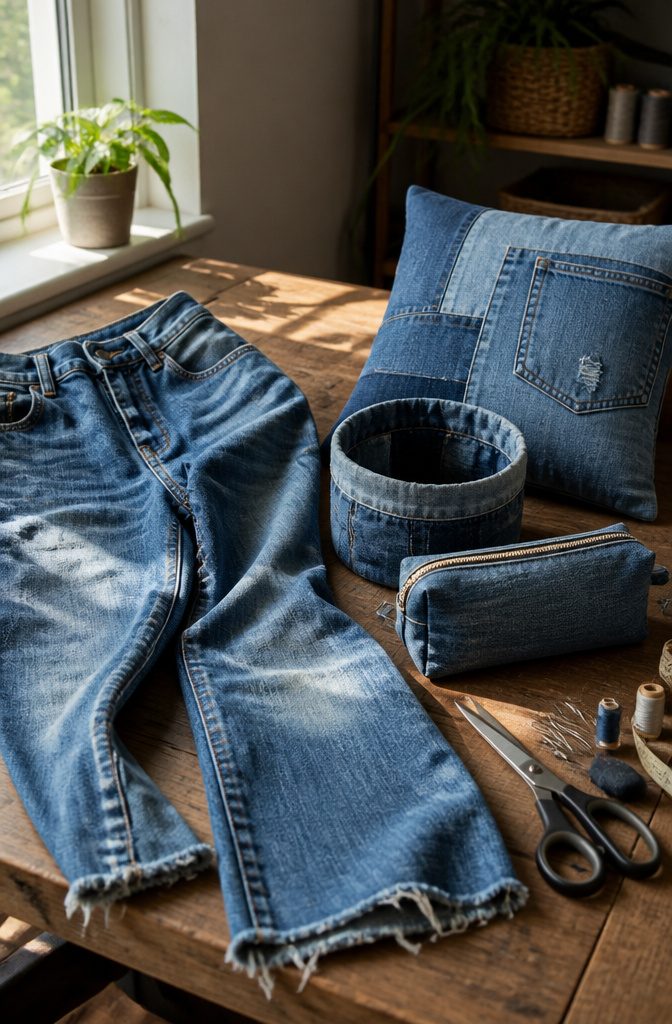
Denim is a tough, resistant fabric, and that toughness is the whole case for reusing it.
A pair of jeans that no longer fits or has gone thin at the knees still has plenty of sturdy cloth in it, and tossing it means sending that cloth to the trash for no reason.
Even jeans with holes or unfixable stains are worth keeping. Cut around the damage and the undamaged panels, especially the legs, are still usable fabric for baskets, pillows, pencil cases and more.
I’d skip donating only when a pair is truly too worn for someone else to wear; otherwise, donate first.
Each project also means one less thing bought new. Denim never really goes out of style, so what you make from it won’t feel dated either.
Frequently Asked Questions
What can I make out of old jeans?
Old jeans can become clutches, tote bags, aprons, baskets, pillows, rugs, keychains, coasters, jewelry, dog toys, wall decor and holiday garlands.
Every part gets used: legs for flat panels, pockets for built-in storage, and hems, belt loops and seams for small projects.
How do I upcycle old jeans?
Wash and dry the jeans, cut off the hems, waistband and thick seams, then work from the flat leg panels.
Sew the pieces with a denim needle and a longer stitch, or glue and tie them for no-sew projects. Mark cuts with chalk and use sharp fabric scissors so the edges stay clean.
What are some no-sew projects for old jeans?
Baskets, coasters, wall decor and garlands all work with glue or knots instead of stitching.
A basket is made by wrapping and gluing denim strips around a sturdy form. Coasters are layered circles or squares glued together, and garlands are strips knotted onto twine.
Can I use old jeans for quilting?
Yes, as long as you cut the denim into patches first.
Small pieces are easier to sew than big panels because denim is heavy. Cut the seams out of the legs and use only the flat sections; one diamond quilt used 3.5" diamonds with a 3/8" seam allowance.
Can I reuse jeans that have holes or stains?
Yes. Cut around the damage and use the undamaged panels, especially the legs, for baskets, pillows, pencil cases and more.
Worn knees are fine for projects like aprons, since the legs get cut off anyway. Donate first only if the pair is still wearable by someone else.