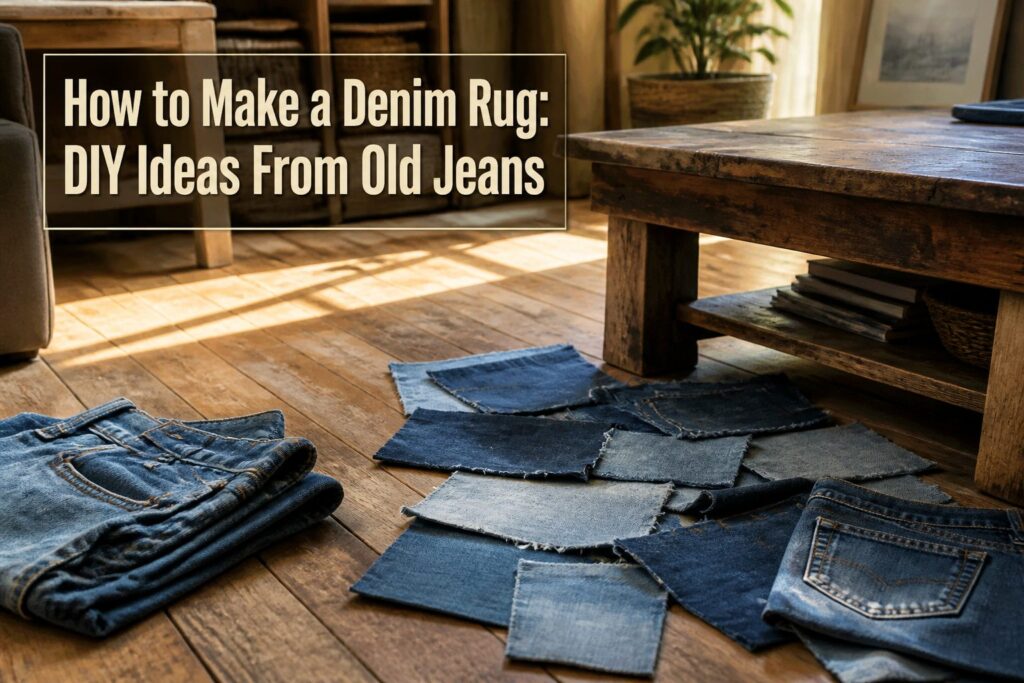
A denim rug from old jeans can be done in one afternoon, with no sewing skill, if you start with the 15.5 x 20 inch mat and a couple of pairs.
The stage people get wrong is the cutting: skip jeans that are more hole than fabric, since thin knees tear when stitched.
1. Waistband Denim Rug
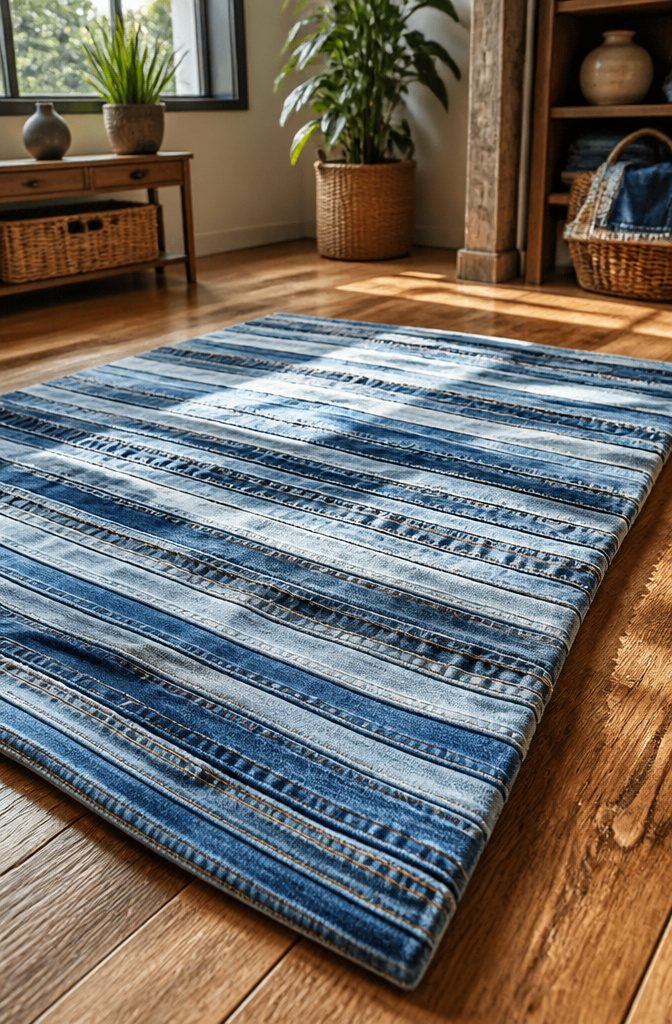
Jeans waistbands are the stiffest part of the pair, and that stiffness is what makes them a good rug unit.
Cut each one off just below the belt loops, then open it at a side seam so you have a flat, doubled strip that holds its shape without any backing.
Lay the strips side by side, either all running the same direction or alternating in a brick pattern.
Keep the button and zipper ends tucked to the outer edge or trimmed off, since hardware under a foot gets uncomfortable fast. Mixing light and dark washes across the rows gives you a striped look with no extra work.
I’d pick this over a thin-leg rug for a spot that gets walked on, because the thick waistband layers resist curling and flattening where plain denim panels wouldn’t.
Bulk is the cost: it sits higher off the floor than a woven rug.
2. Woven Denim Rug
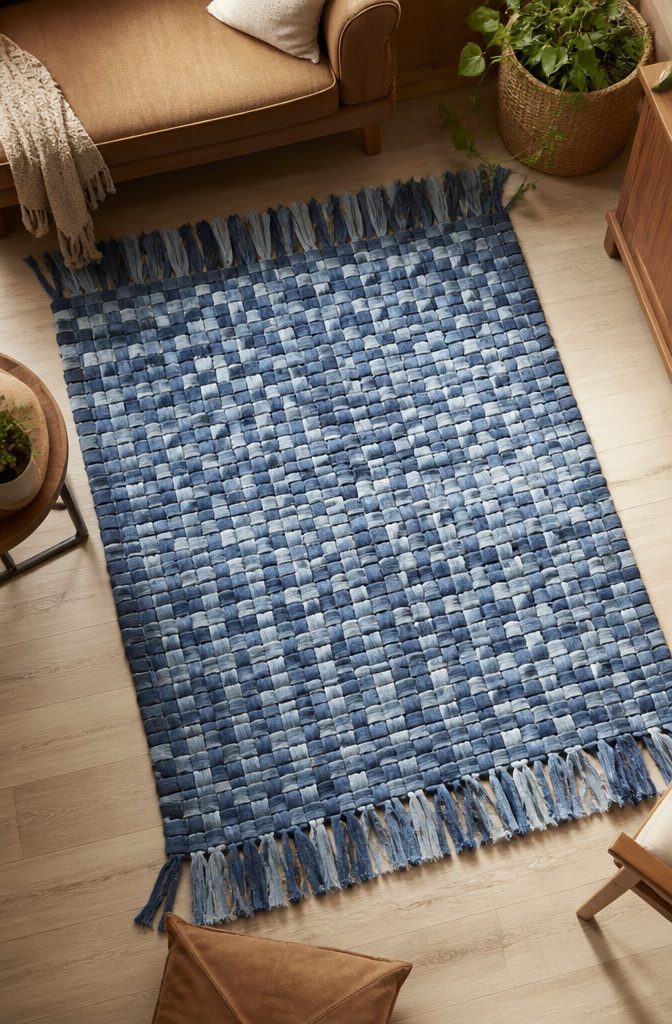
Weaving works because denim strips behave like loom thread: lay the vertical strips side by side, then pass each horizontal strip over one and under the next, flipping the pattern on every row.
Leave 2.5–3 inches of strip hanging free on all sides, since that becomes the fringe. A clay-modeling tool pushes each row up snug, and painters tape on the edges after every 3–4 rows keeps the weave from creeping apart.
Once the length is right, tape the bottom, then stitch a denim strip along each woven edge with a #100 denim needle and 3 seams. A side seam from the jeans works well for this.
For a diagonal blue jean version, turn the weave 45 degrees so the strips run corner to corner.
3. Sewn Denim Rug
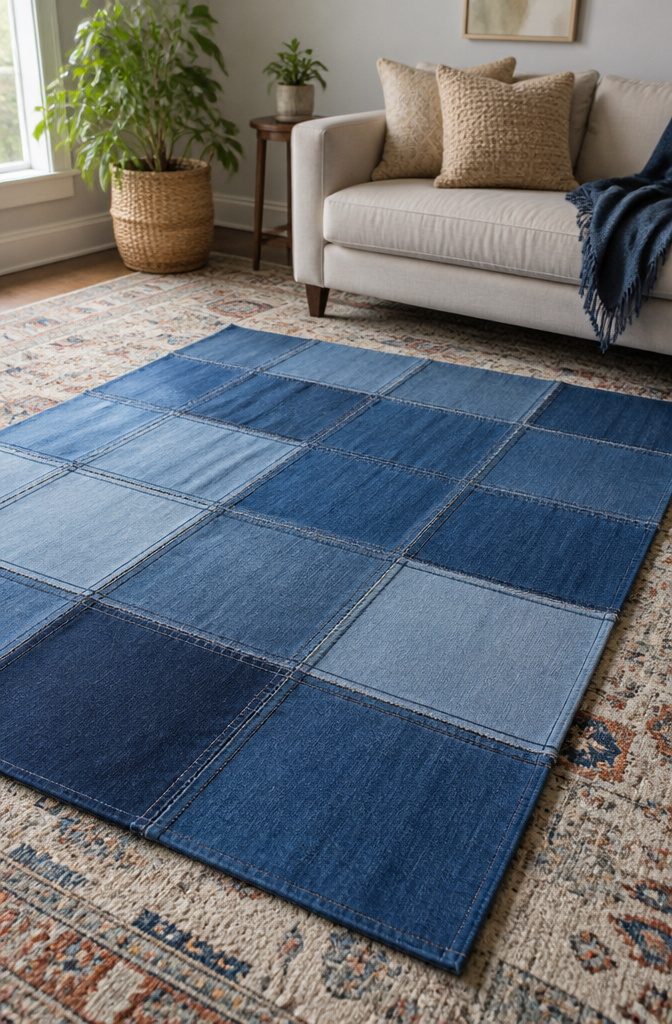
Sewing denim squares or strips together on a machine gives you the flattest, most store-like rug of the bunch.
Use a denim or heavy-duty needle, a longer stitch, and sew each seam twice so it holds up to foot traffic. Press the seams open before you go on, because bulky seam allowances make a lumpy surface.
Backing is what makes the rug last.
Sandwich a layer of cotton batting between the patchwork top and a back layer, then quilt through all of it. Batting adds cushion and keeps the top from stretching.
For a rug on hardwood or tile, I’d choose grip cloth as the bottom layer, since it stops the slide that makes a sewn rug a hazard. Batting alone looks nice and slips.
4. Braided Denim Rug
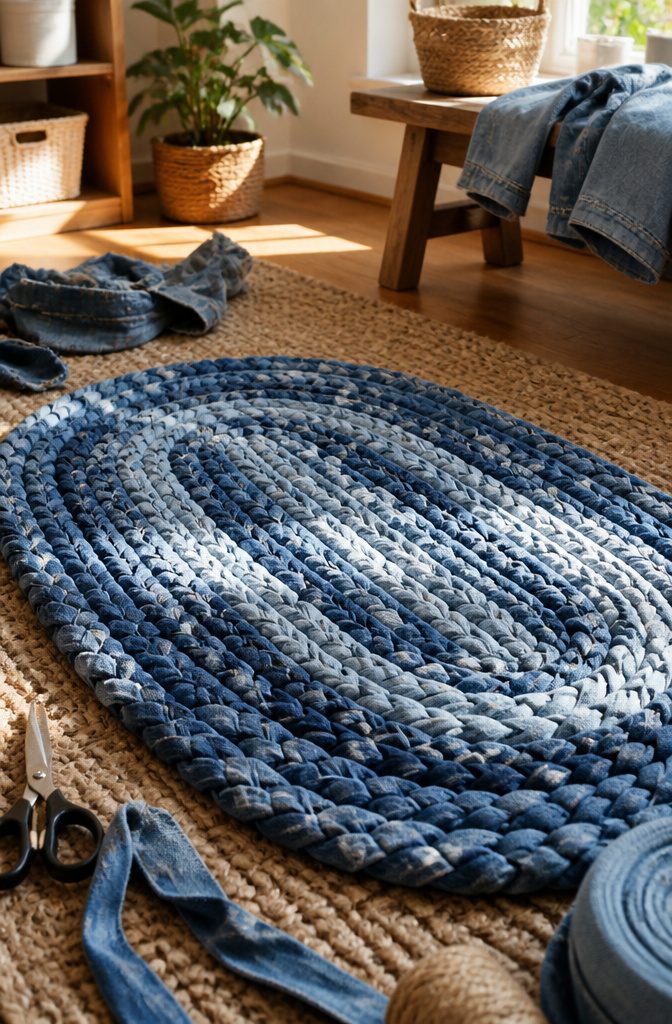
Braiding is the easiest route to a denim rug if you can already do a three-strand hair braid, and it is much easier than sewing one from scratch.
You need no pattern, no measuring and no machine skills. Join three long strips, braid them flat and snug, then coil the braid into an oval and stitch it down.
Hand-stitching works fine, but a sewing machine on a zigzag setting goes faster and holds better. Stitch between the braid loops, not across them, so the thread disappears and the rug lies flat.
Wide strips braid quickly and make a chunky, forgiving rug. Thinner ones look neater, but they take far longer.
5. Crochet Denim Rug
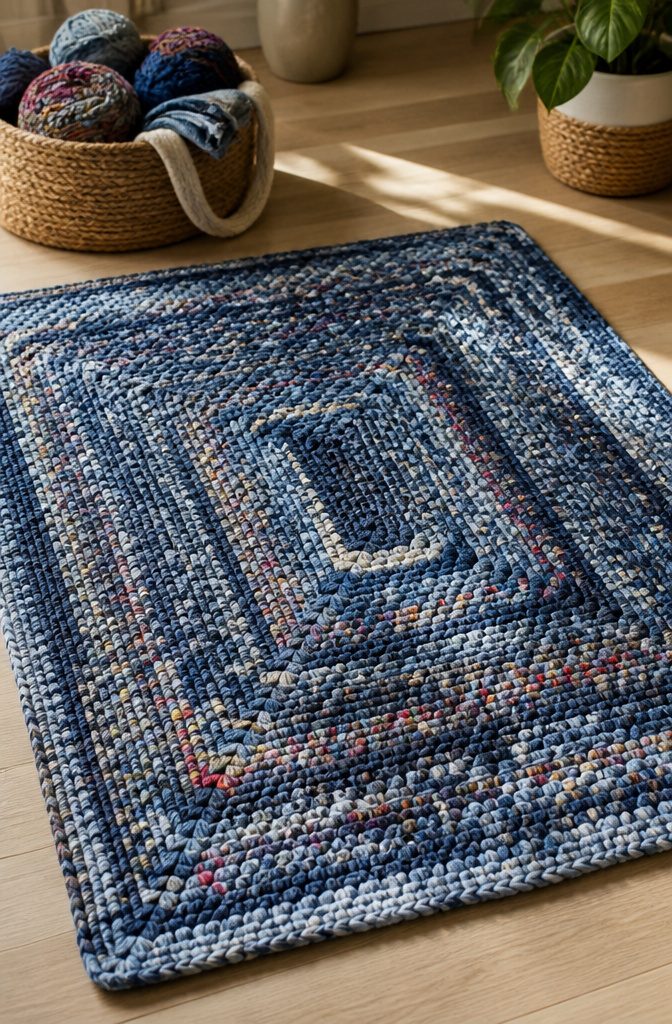
Crocheting with denim works much like crocheting with t-shirt yarn: cut or turn old jeans into a continuous strip, then work it with an extra-large hook. A regular hook will not pass that fabric through a stitch.
Two routes look good. Denim yarn made from several pairs of jeans lets you vary the indigo shades into patterns.
Rolled strips from the legs can be crocheted together with colorful yarn, the way a cotton rag rug is built, and the yarn adds color.
Caitlin Wilson of Capper’s Farmer puts the project’s appeal simply:
It’s a project that’s forgiving of mistakes, and it makes use of the perfectly fine fabric hiding in unwearable pants.
That makes it a good first crochet project. Skip jeans that are more hole than fabric, or any with stains that won’t wash out.
6. Denim Rag Rug
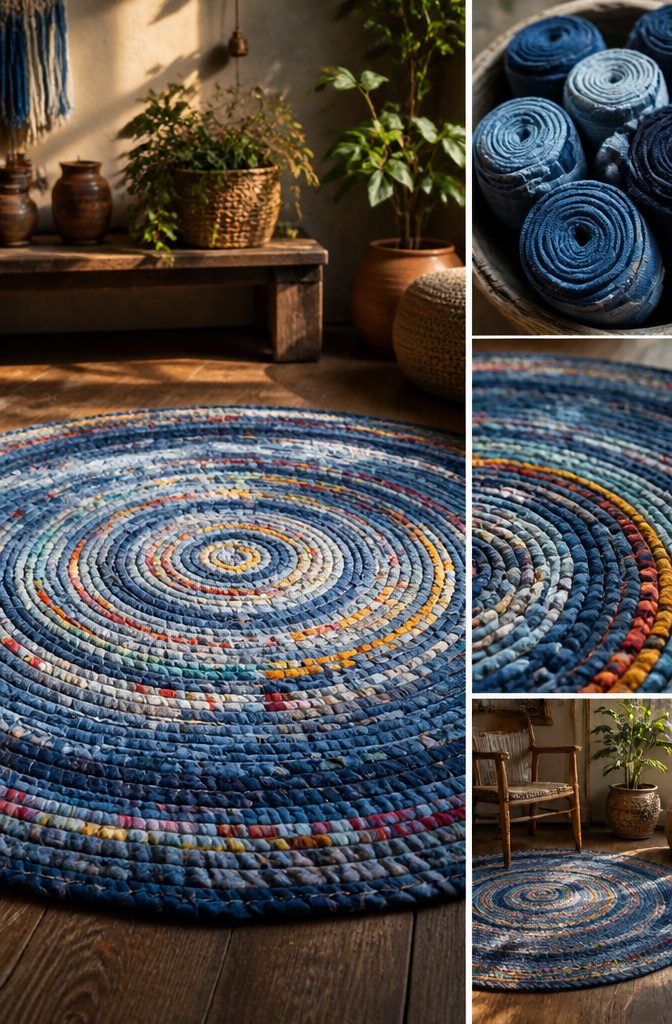
A denim rag rug starts with the legs of old jeans cut into long strips, which are then rolled, braided or crocheted into a flat, sturdy mat.
The traditional version is the one I’d start with: it uses up scraps left from other projects and gives a home to pants too worn to donate.
The colorful version rolls the strips and crochets them together with bright yarn. The yarn adds a stripe of color between the blue rows, so the rug reads as playful instead of plain.
Mix light, medium and dark denim for shading. Keep out jeans that are more hole than fabric, and anything with stains or grease spots that won’t wash out.
7. Denim Seams Rug
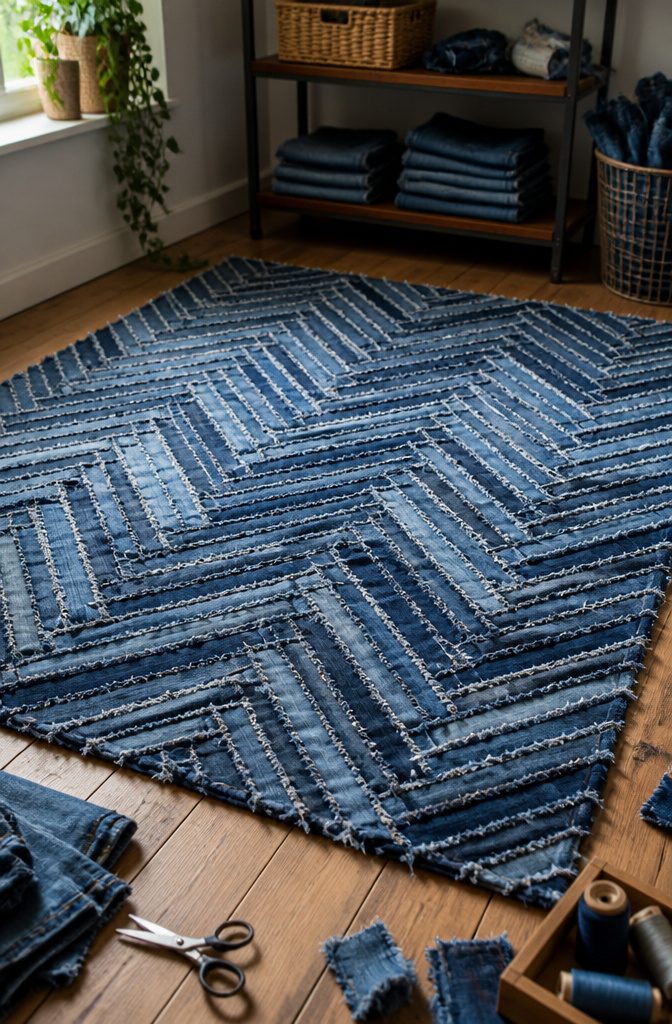
Seams are the part of old jeans most people toss, and they make a surprisingly good rug material.
Cut them off with scissors and favor the inner seams, since those are usually double stitched and hold up well under weaving and foot traffic. Single-stitched seams work too, because they fray nicely after washing.
Quantity is the catch. A rug woven from seams used strips from almost 50 pairs of jeans, so a door mat is a big commitment.
I’d start with a trivet, placemat or candle mat, which needs far less denim. You’ll want basic weaving skills, but no sewing is needed until the last stage.
8. Denim Pocket Doormat
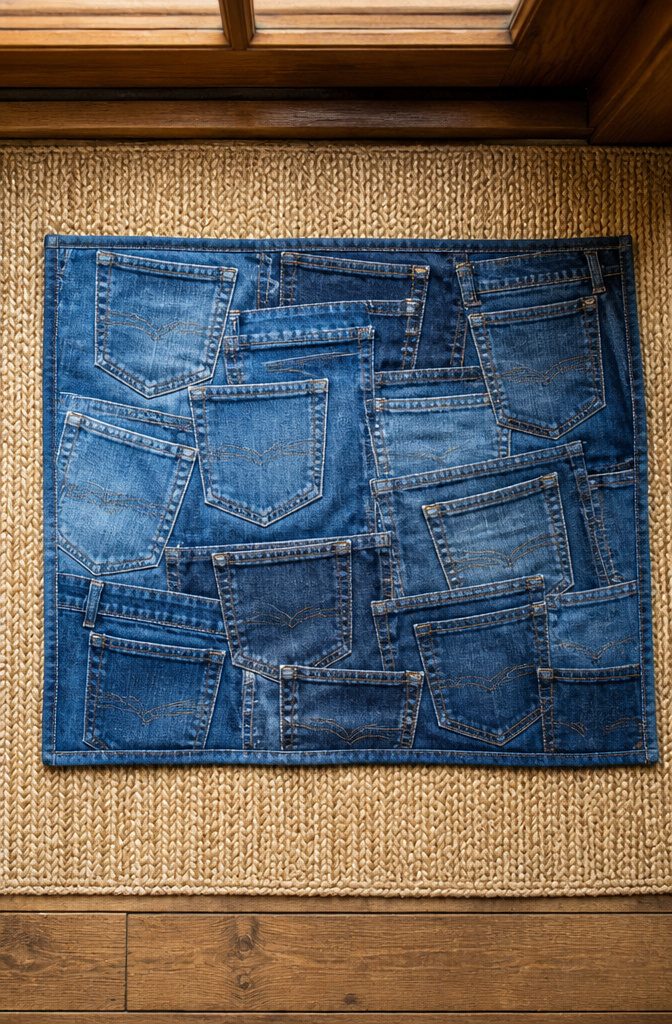
Back pockets make the best doormat material because they already come with stitching, a pocket shape and a bit of texture.
Cut each one out with about an inch of denim around it, so the seam stays anchored and nothing frays at the stitching.
Lay the pockets on a non-slip rug pad or a piece of sturdy canvas in tight rows, edges touching, and stagger the rows like brickwork.
Sew or glue each one down, then topstitch around the outer edge. A 15.5 x 20 inch finished mat is a good size to aim for, since it fits in front of a door and uses a manageable pile of jeans.
For the pocket rug variation, I’d leave the pockets open and facing up. They catch grit and flatten less than a sewn-down panel, though they do collect dirt, so shake the mat out often.
9. Handmade Chevron Rug
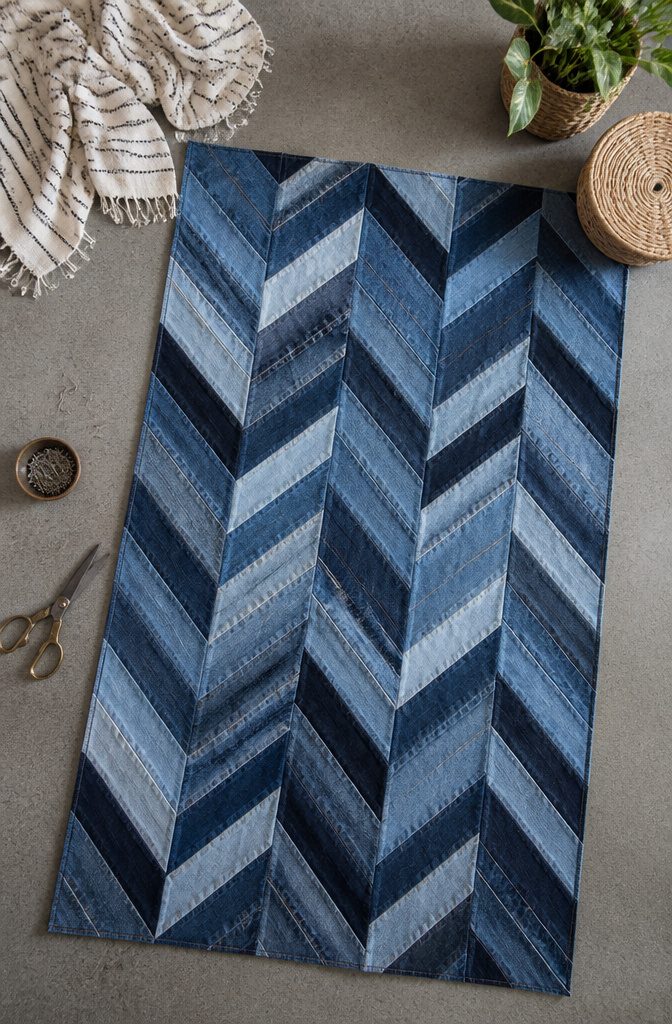
Chevron looks harder than it is, because every piece is just a strip with one end cut at an angle.
Cut denim strips of equal width, then trim both ends of each strip at the same slant, usually 45 degrees, so they become parallelograms. Sort them into piles by shade, from dark indigo through mid-wash to the pale, nearly white pairs.
Lay the first row so the strips lean left, then flip the next strip to lean right.
Where they meet, a V forms. Repeat down the length, and keep the seam lines of the V meeting at one center point or the zigzag drifts sideways.
I would stitch the pieces onto a backing, such as canvas or a non-slip mat, rather than sew them to each other. Pin every strip before sewing, and expect stiff seams to bend a needle.
10. Large Round Blue Jean Rug
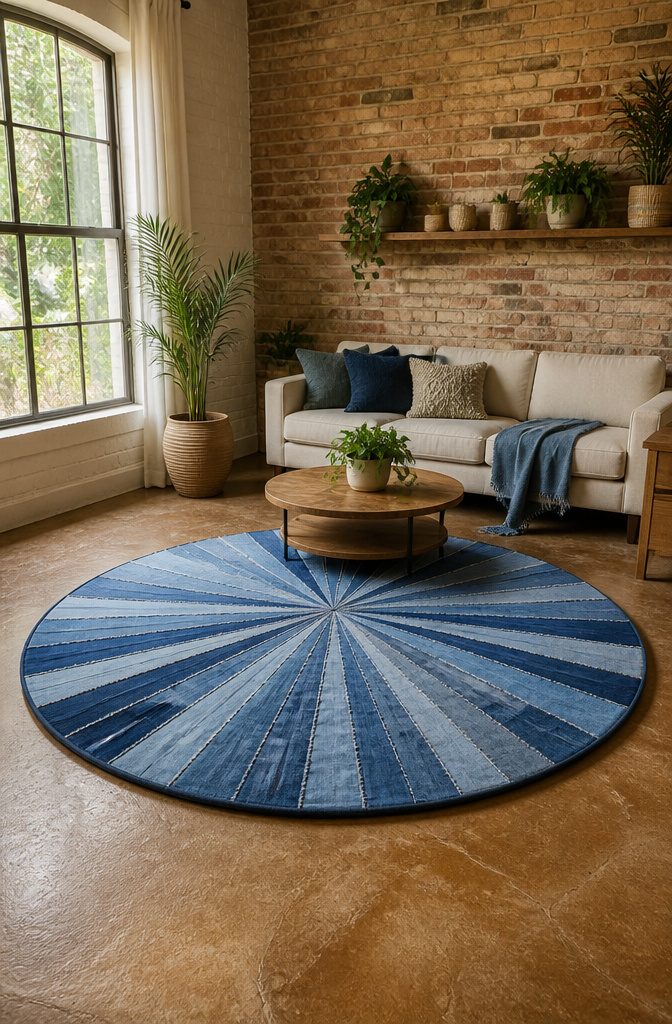
A round denim rug reads like a sunburst, with indigo rays spreading out from the center.
Most of the material comes from the legs of old jeans, which are the widest stretches of seam-free fabric you get. I’d estimate about 6 pairs of jeans went into the big version.
The shape asks more of you than a rectangle does, because every ring has to grow evenly or the edge ripples. If you’re short on jeans, make a smaller circle rather than stretching the supply thin.
Mixed washes work in your favor here: pale and dark legs alternating give the rays their definition. I’d pick this over a plain rectangle for a bedroom, where a circle softens the straight lines of the bed and dresser.
11. Denim Yarn Rug
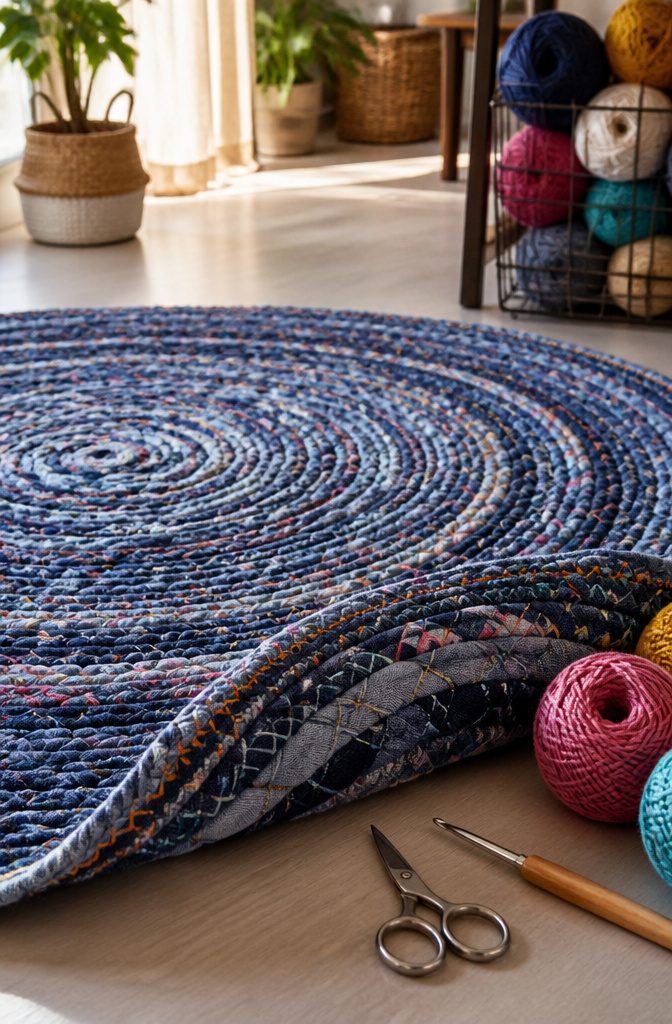
Cut each jean leg off just below the crotch, lose the cuffs, then slice straight across the leg about 1 inch from the bottom edge, stopping ½ to 1 inch short of the far side.
Keep making parallel cuts, rotate the leg, and cut diagonally from each pair so the leg becomes one continuous spiral strip. Lumps and sharp angles disappear in the finished rug.
Wind the strip around a tennis ball for a firm core, or around your hand a few times. Sew each new strip on right sides together.
The center of the ball ends up as the rug’s outer edge, so plan any stripes or gradient backward. Then crochet it with a large hook.
For a flatter option, cut about 50 hexagons from varied shades and sew them together.
12. Denim Mat
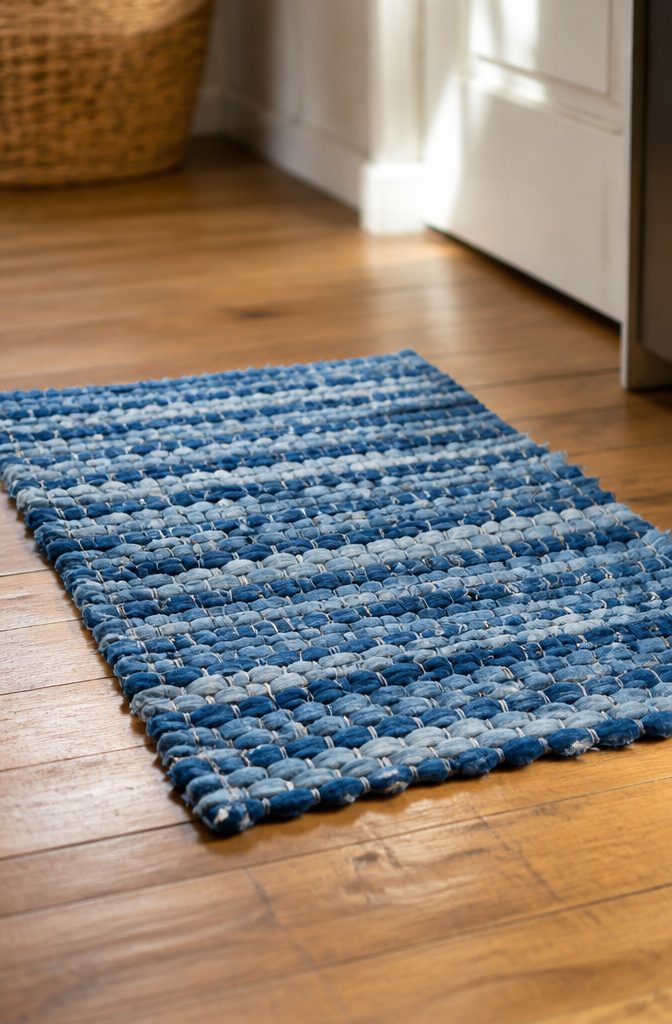
A denim mat is the project I’d hand to anyone who has never made a rug.
It finishes at 15.5 x 20 inches, small enough to complete in one afternoon and small enough that a crooked row or a wobbly edge won’t bother anyone.
That size also keeps the material list short.
A couple of pairs of old jeans will cover it, and you can use whatever tools are already in the house. Mistakes cost you a few strips of fabric rather than a whole rug’s worth.
I’d start here before trying anything larger. The mat teaches you how denim behaves: how stiff it is, how it frays, how much patience the cutting takes.
Put it by the sink, at the back door, or under a pet bowl, and you’ll know whether you want to build a full-size rug.
Materials for a Denim Rug
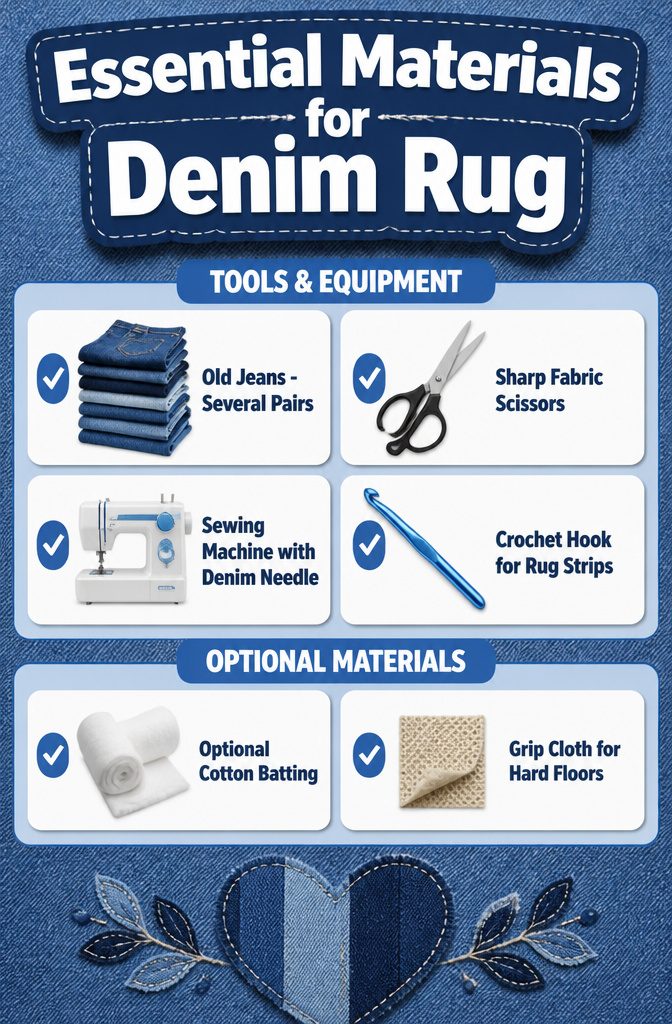
Most of what you need is already in the house. Here is the full kit:
- Old jeans: Several pairs, in a mix of shades if you want contrast. Heavier, sturdier denim holds up best underfoot.
- Scissors: Sharp fabric shears. Dull blades chew through thick seams and tire your hand fast.
- Sewing machine: Needed for sewn and stitched rugs. Use a denim needle and strong thread.
- Crochet hook: A large hook for crochet rugs, sized to fit your cut strips.
- Cotton batting: Optional, but it adds cushion to flat designs.
- Grip cloth: Optional, and I’d add it on hard floors so the rug stays put.
Skip jeans that are more hole than fabric or carry stains that won’t wash out. Thin knees tear when stitched, and stains show on a finished rug.
Cutting and Preparing Denim
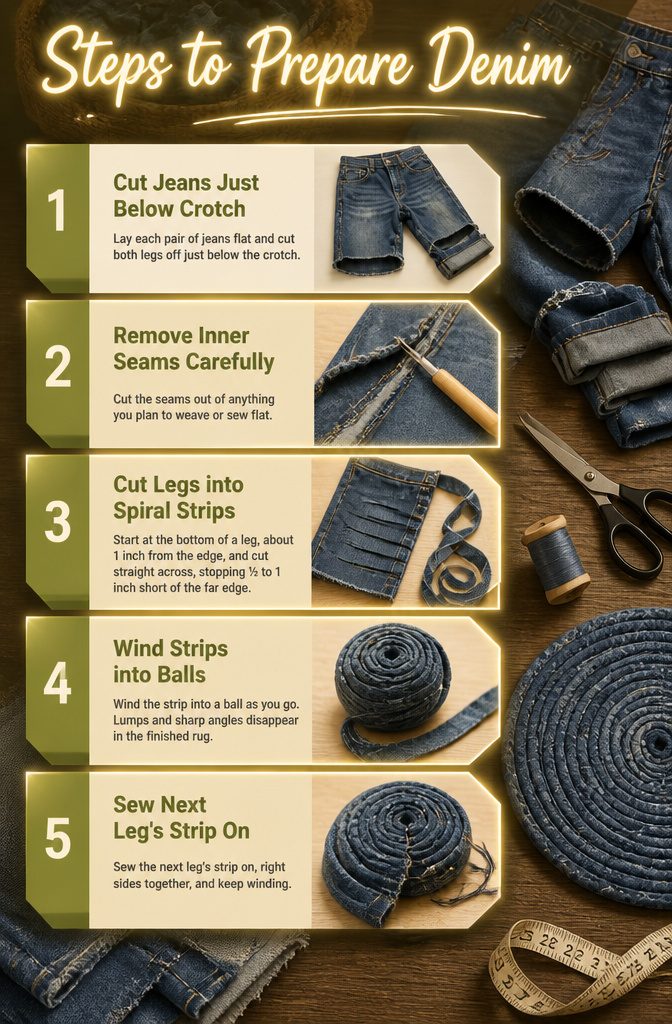
- Lay each pair of jeans flat and cut both legs off just below the crotch. The upper section goes in the scrap pile, and the cuffs go with it.
- Cut the seams out of anything you plan to weave or sew flat. The inner seams are usually double stitched, and single-stitched ones fray nicely after washing, so they work too.
- Start at the bottom of a leg, about 1 inch from the edge, and cut straight across, stopping ½ to 1 inch short of the far edge. Repeat down the whole leg, then turn it and cut diagonally from one cut to the next. That turns each leg into one continuous spiral strip.
- Wind the strip into a ball as you go. Lumps and sharp angles disappear in the finished rug.
- Sew the next leg’s strip on, right sides together, and keep winding.
Washing and Care
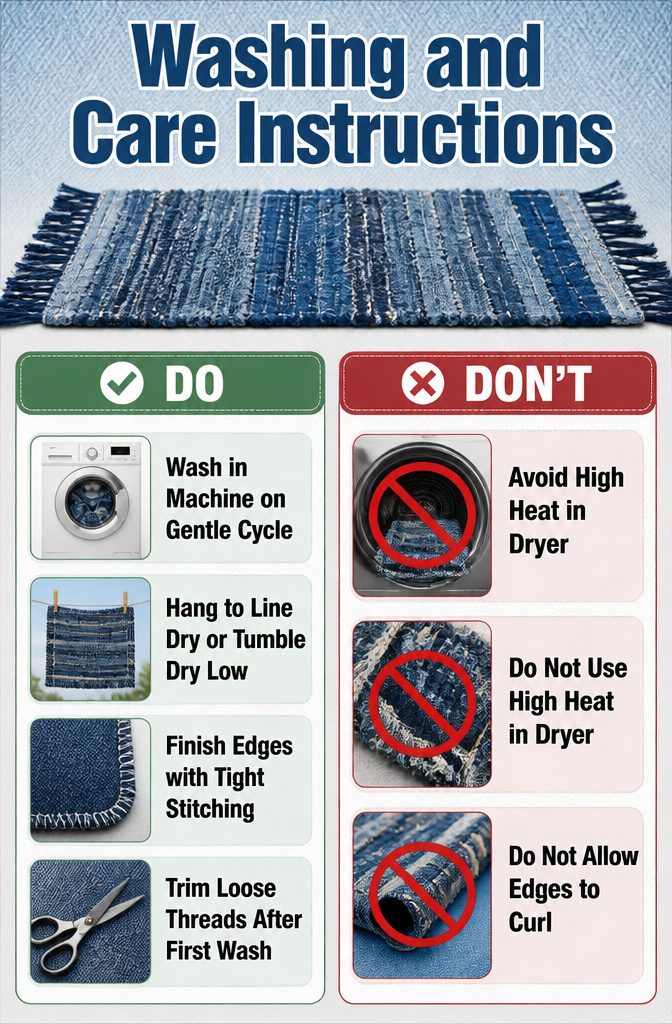
Denim rugs go in the washing machine, which is a big part of why old jeans make such a practical rug.
After a wash, hang the rug to line dry, or tumble dry it on low heat. High heat is the setting I would avoid, since it can distort a rug and leave the edges curling.
Edges decide how long a rug lasts in a hallway or by the back door.
Raw cut strips fray with every wash, so finish the edges with a tight row of stitching or a bound border before the rug sees real foot traffic.
A rug that gets stepped on daily needs the extra row. Expect some loose threads after the first wash; trim them rather than pulling.
Frequently Asked Questions
What materials do I need for a denim rug?
At minimum you need several pairs of old jeans and sharp fabric shears.
Add a sewing machine with a denim needle and strong thread for sewn rugs, or a large crochet hook for crochet versions. Cotton batting adds cushion, and grip cloth keeps the rug from sliding on hard floors.
Can a denim rug go in the washing machine?
Yes, denim rugs can be machine washed. Line dry the rug afterward, or tumble dry on low heat, since high heat can distort it and make the edges curl.
Finish raw edges with a tight row of stitching or a bound border first, because cut strips fray with each wash.
Can I use any type of denim for a rug?
Most old jeans work, but skip pairs that are more hole than fabric or have stains or grease spots that won’t wash out.
Thin, worn knees tear when stitched, and stains show on the finished rug. Heavier, sturdier denim holds up best underfoot, and a mix of light, medium and dark washes gives you shading.