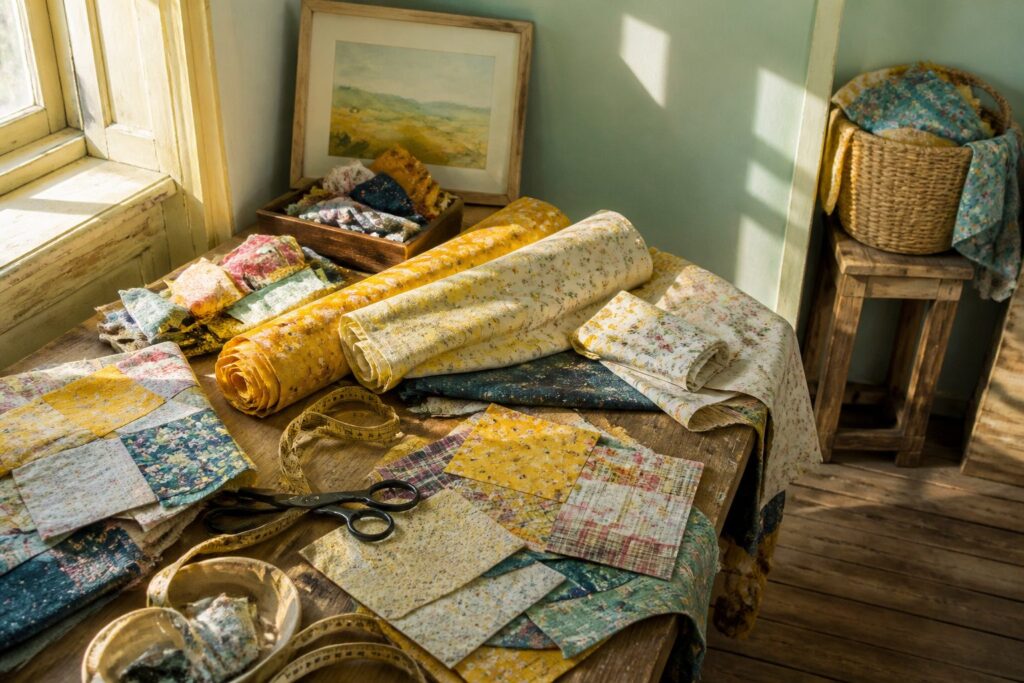
Scrap fabric projects run from a 15-minute star pillow to a bed quilt that takes days, and the deciding factor is the size of your pieces.
Strips and tiny bits suit scrunchies, ornaments and bookmarks. Bigger projects, like jewelry cases, quietly call for fat quarters, which stretch the definition of "scrap."
1. Fabric Coasters
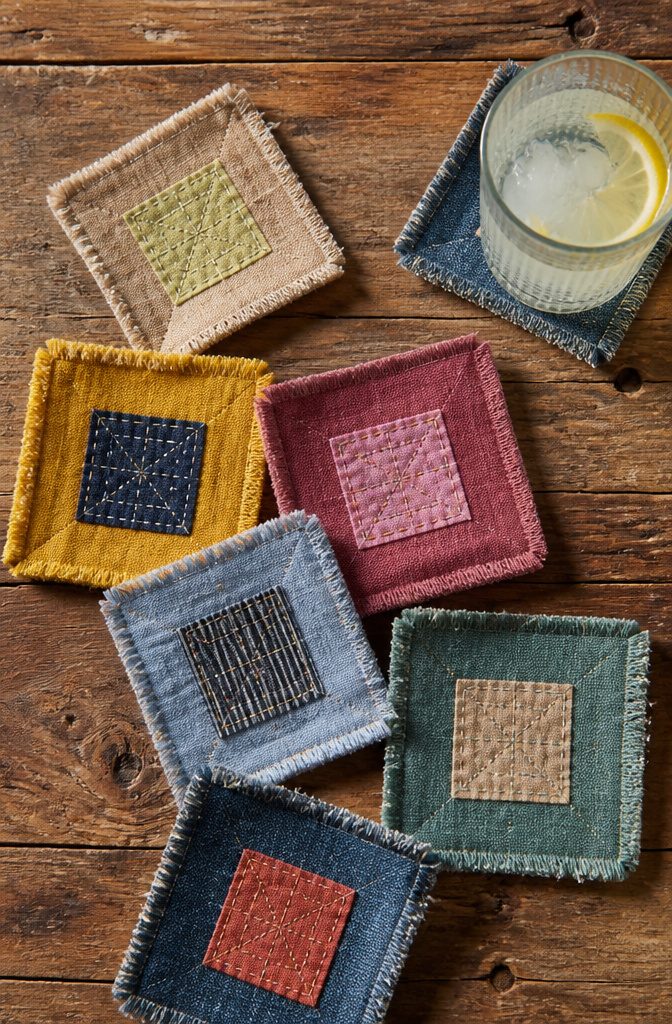
Coasters are the easiest place to start with scrap fabric, and they are beginner-friendly because a square of cloth and a few straight stitches finish the job.
Quilted stitches through the center do double duty: they decorate and they hold the layers together, with a couple of layers of batting inside for cushion.
Fabric choice matters more than scrap size. Sturdy cloth like linen or upholstery fabric wins, since it stands up to a wet glass.
Cut it into squares and lightly fray the edges for a casual look, which skips the sewing altogether. Mixing colors in one set works fine, so a scrap too small to make four matching coasters is no problem.
2. Scrappy Tote Bags
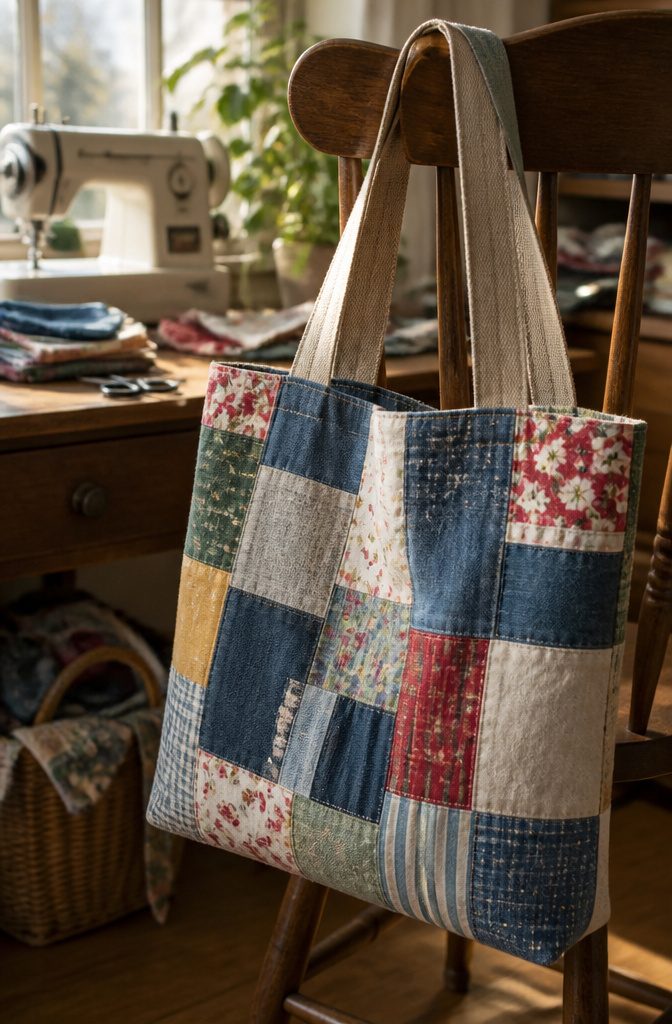
Piece the scraps into one flat panel before you cut anything. Sew strips or squares together, press the seams open, then lay your bag pattern over the finished fabric and cut front and back from it.
Cutting the shapes first and patching each piece afterward leaves you with mismatched edges and seams that land in the wrong places.
Mixed scraps are the point here, so pull from several sources: quilting cotton, a worn shirt, a curtain remnant, a scrap of denim, even a bit of vintage linen.
Fusible interfacing pressed on the back keeps stretchy or thin pieces from wrinkling the panel.
Straps are where scraps let you down. Cut the handles from a sturdier fabric such as canvas, denim or webbing, because pieced seams will pull apart under a full load of books or groceries.
3. Fabric Scrunchies
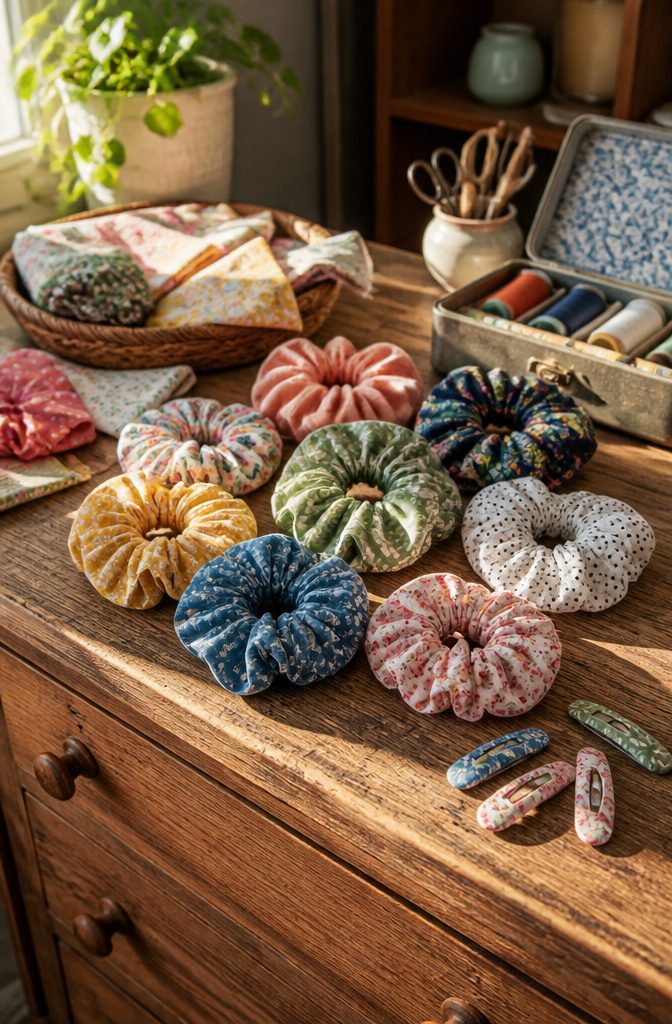
Scrunchies are the best use I know for long, narrow scraps, since the fabric only has to be a strip and the rest is gathering.
A strip pulls up around a loop of elastic, and you can buy the elastic bands online or at a local sewing shop.
Sewing the casing closed around the band is the whole finish, so one scrunchie fits easily into an afternoon with time to spare.
For fabric, pick something that bunches softly, because the puffy gathers are what make a scrunchie look like a scrunchie.
Lightweight, drapey cottons ruffle nicely. Stiff or heavy fabrics fight the elastic and look bulky.
A batch also makes good gifts for teens and tweens, and matching a scrunchie to an outfit is half the fun.
4. Patchwork Pillows
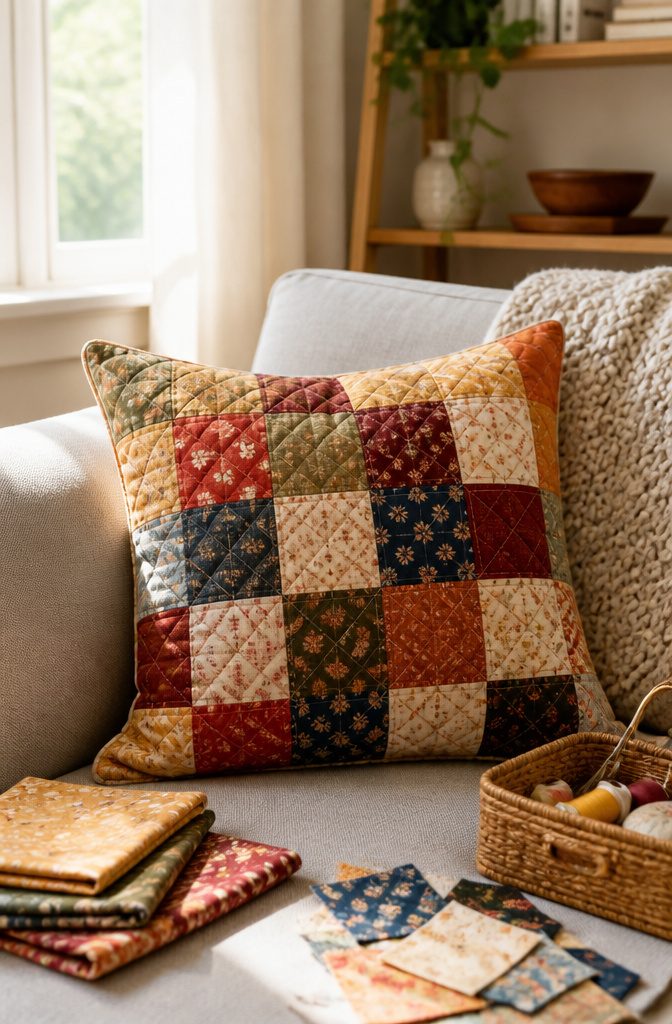
Patchwork pillow covers reward a little trial and error with weights and weaves. Lay your scraps side by side before you sew, and test which colors and patterns you love together and which fabrics hold up structurally.
A flimsy cotton next to a heavier weave can pucker at the seams, so I’d keep each cover to scraps of similar weight.
A simple square layout keeps this an afternoon project: cut squares, sew them into rows, join the rows, and finish the cover. No curves, no odd angles.
Because the cover is the only thing you make, it also works as a seasonal swap.
Sew one in festive scraps and trade it in for the next holiday. A star pillow takes about 15 minutes if you want something quicker.
5. Fabric Bookmarks
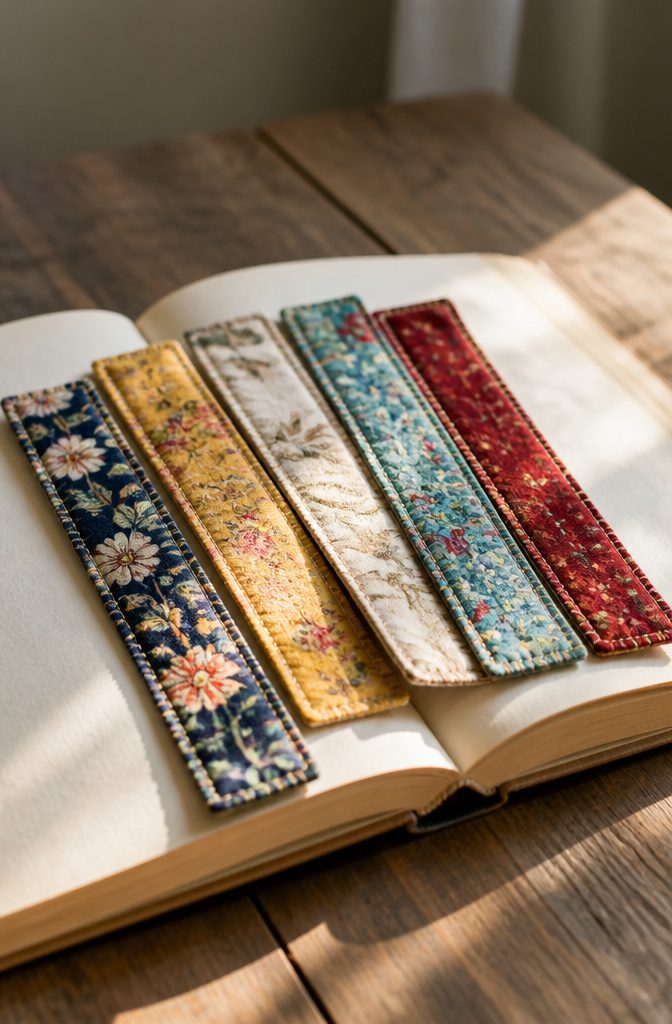
Bookmarks are the easiest place to start with small scraps, because a strip of fabric barely bigger than your hand is all one needs.
Beginners and kids can sew them, and they work as gifts or stocking stuffers for any holiday.
Interfacing is what makes them work.
Fused to the back, it stiffens the strip so it stands up in a book instead of flopping, and it keeps the edges from folding over. I’d use a sheer weight so the bookmark stays thin between the pages.
Plan on making more than one, since each takes so little fabric.
Dress them up with decorative stitching, buttons, sequins, or a tassel at the top. Slip-on styles that hug the page corner are my pick over a plain strip, because they never leave a dog-eared page.
6. Gift Card Holders
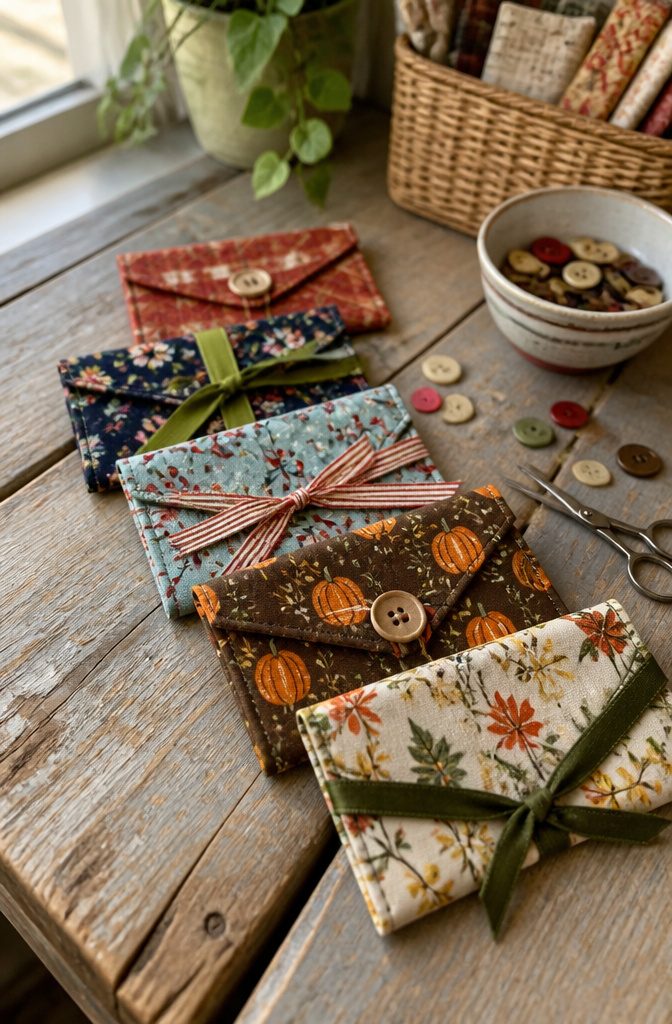
Gift cards feel impersonal, and a small holder made from scrap fabric fixes that for almost no money.
The simplest version is cotton fabric with a single line of stitching, so it sews up fast and uses a piece you were about to toss.
Adding ribbon scraps gives you a tie or a trim, and that is the version I would make for birthdays.
For the holidays, cut from a seasonal print. A Christmas tree pillow can double as a holder, which suits someone who would rather keep the gift than throw out the wrapping.
If you own a zipper, a pouch is the sturdier choice. It takes about 30 minutes, and afterward it holds coins or beauty products.
7. Bowl Cozies
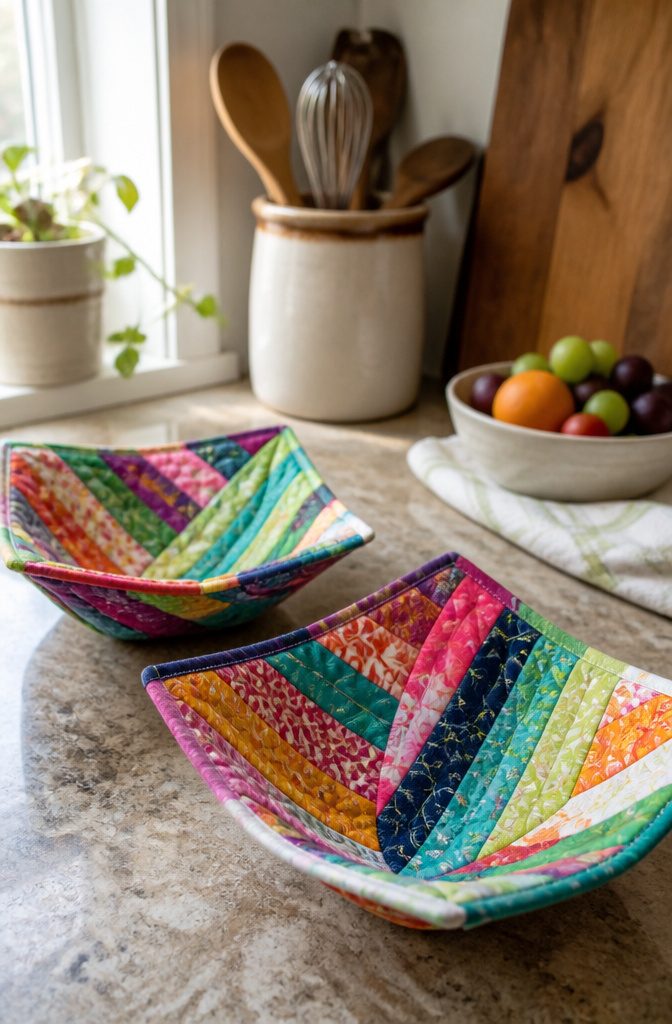
Cotton is the fabric to reach for here, because a bowl cozy lives in the microwave and has to protect your hands when you pull out something hot.
Synthetics can melt or scorch. A scrap of quilting cotton, ideally two layers, handles the heat and washes easily.
Scraps suit the job well, since a cozy only needs a few pieces.
A string-pieced top, built from narrow strips sewn side by side, uses up your skinniest offcuts. Heather Handmade even shows two ways to build one, so you can pick the simpler method if you’re short on time.
For gifts, I’d make a stack of them ahead and keep them on hand for birthdays and stocking stuffers. Pair two matching cozies with a pretty bowl and the whole present costs little.
8. Reusable Snack Bags
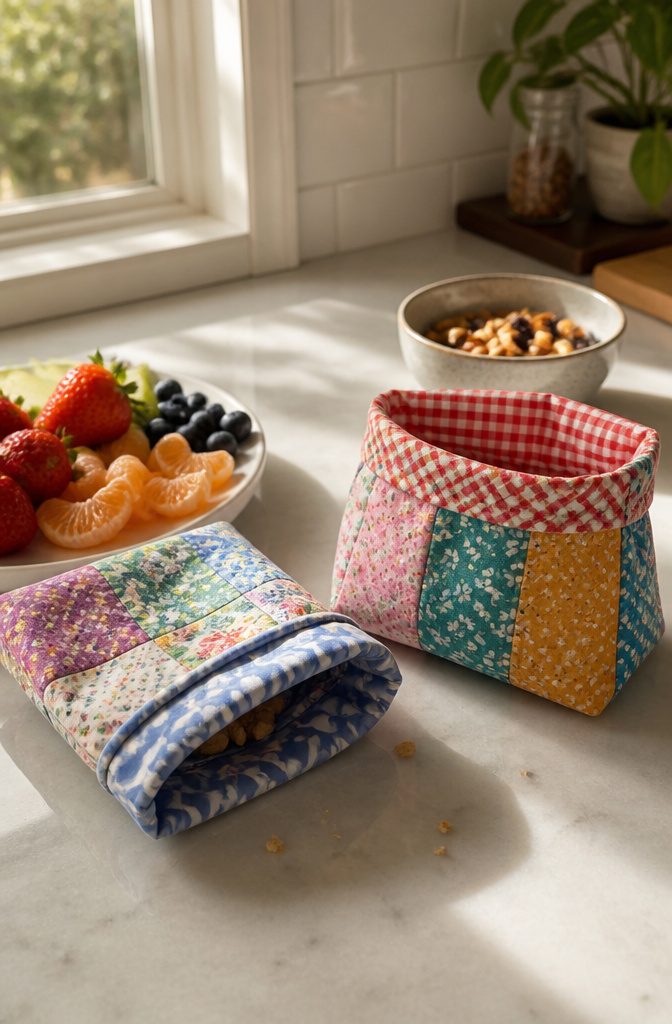
A snack bag lives or dies by its lining. Cotton scraps alone soak up crumbs and moisture, so pair them with a nylon or PUL liner, which wipes clean and goes through the wash without fuss.
I’d pick PUL for anything wet, like cut fruit, and nylon for dry snacks.
Choose a tightly woven cotton for the outside, since it can handle repeated laundering. Wash the fabric before you cut so nothing shrinks after the bag is sewn.
Each bag takes only a small amount of fabric, so it’s one of the better homes for odd pieces.
A roll-down Velcro closure is the simplest option, and it also works at lunch-bag size. Fat quarters are a bit big to count as true scraps, but they suit zip pouches well.
9. Fabric Ornaments
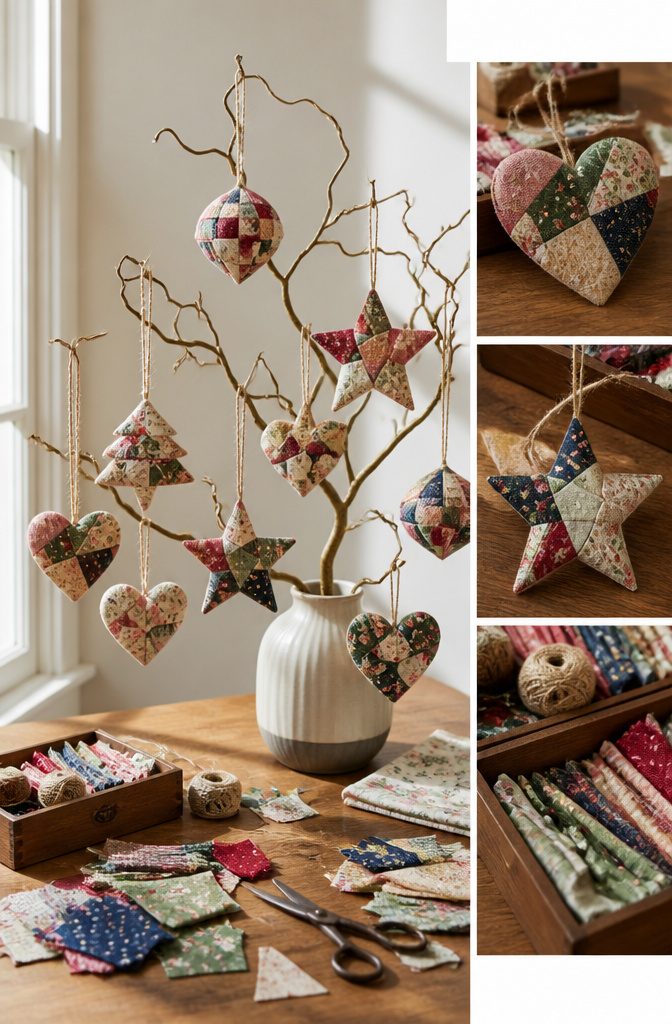
Ornaments ask for less fabric than any other project here, so they suit the scraps too small for anything else. Cardstock makes a good base for flat ones.
Glue improvised patchwork onto it and the piece needs no quilting, which keeps a tiny Christmas print from being wasted. Strip piecing is the other route: sew narrow strips together into a block, then cut a tree shape from it.
If you already have scraps backed with fusible web, you can fuse them into a patchwork cloth and cut hearts to hang.
I’d choose cardstock-backed flat ornaments for a first batch, since they skip stuffing and finish in an afternoon. Stuffed shapes feel nicer in the hand, but they take more sewing.
10. Fabric Bunting
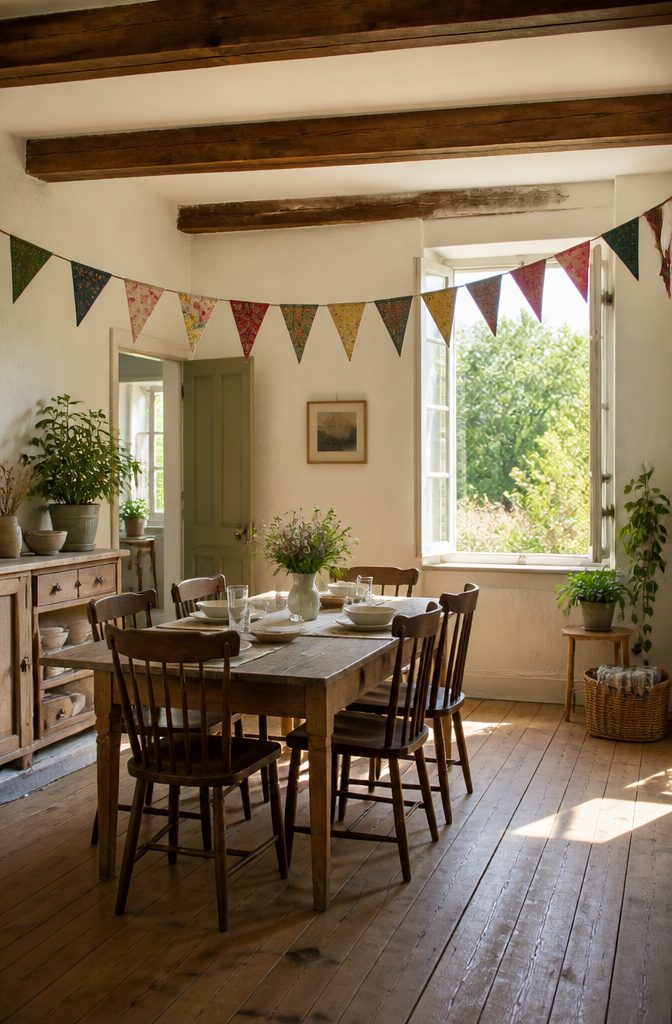
Bunting is the easiest way to turn a pile of mismatched scraps into something people see.
Cut triangles from whatever you have, then string them along twine or tape. One fabric looks tidy; mixing prints and colors looks playful, and that is the version I’d make from leftovers.
Triangles aren’t the only shape.
Rectangles, notched rectangles, scallops and color-block pieces all work, so pick by what your scraps allow. Narrow strips suit rectangles, while a scrap with a curved edge can still become a scallop.
Bunting also earns its keep across the year.
It suits a birthday party or a kid’s room, and a set in holiday prints for Christmas, Halloween or Easter can come out of storage every year. I’d make one seasonal set first, since it uses the smallest scraps.
11. Fabric Jewelry Cases
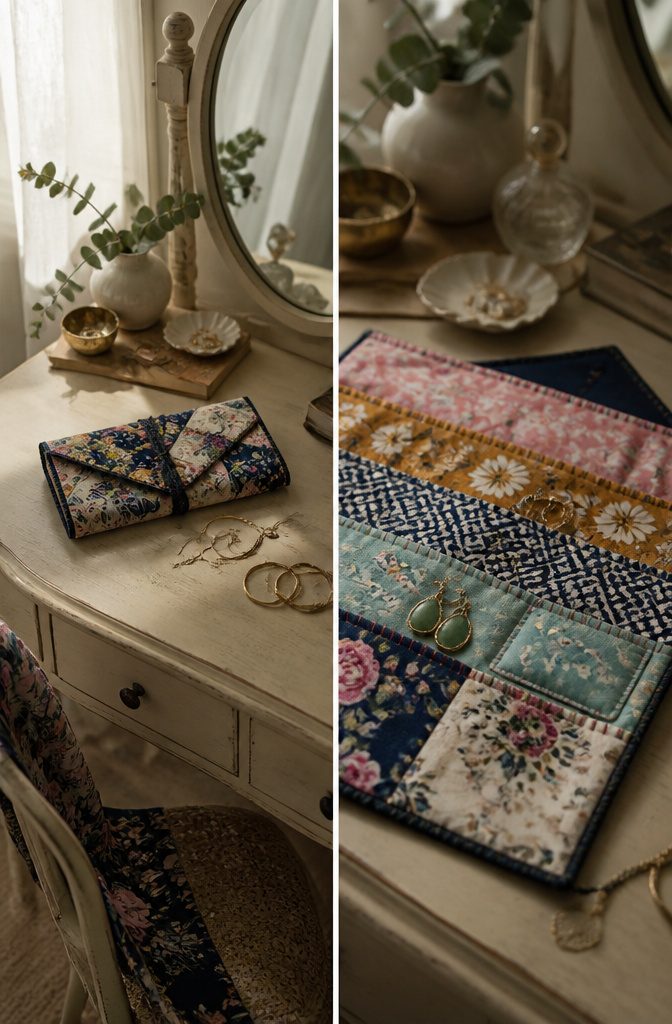
Jewelry cases ask more of your scraps than most projects here. A travel roll or zip pouch needs pieces bigger than leftover trimmings, and fat quarters from a fabric pack are the right size.
Strictly speaking, that stretches the idea of "scrap," but I think it’s a fair trade for something you’ll actually pack.
The roll-up envelope is the easier route.
It needs no complex sewing, and you can add more compartments if you own a lot of earrings. A zip pouch asks for more confidence at the machine, so I’d start with the envelope.
Mixing prints is normal with scraps. Start with one color family, then pair an organic print with a geometric one, or a large-scale print with a small one.
12. Eye Pillows
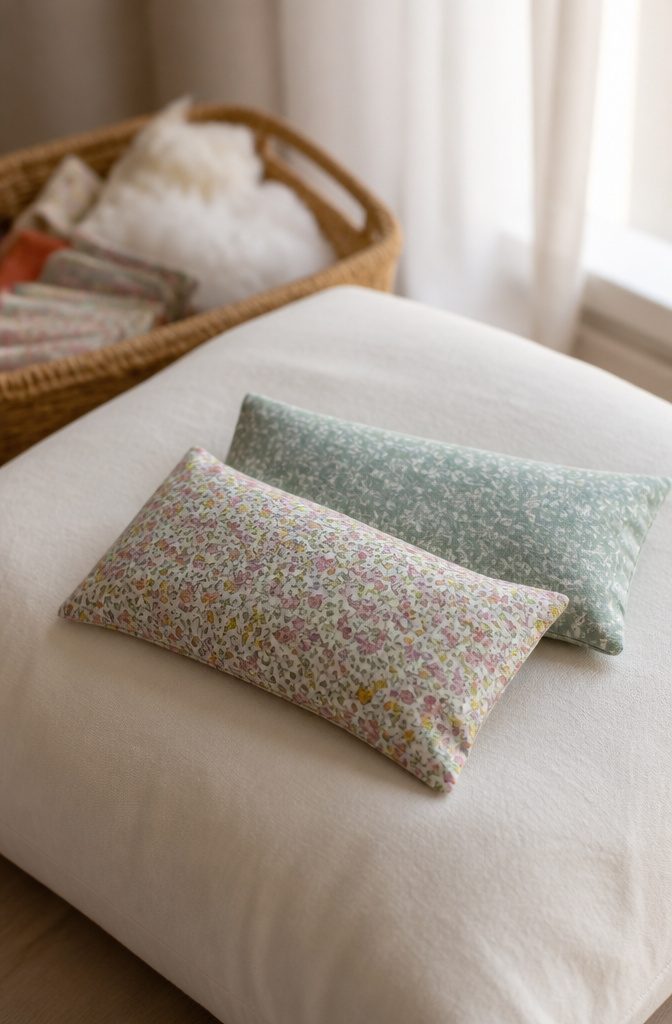
Eye pillows are about the simplest sewing project a scrap bin can fund: two small rectangles, three sides stitched, a filling poured in, and the last side sewn shut.
Cut the pieces roughly twice as long as they are wide so the pillow drapes over both eyes without sliding off.
Fabric choice matters more than the pattern. Pick something soft against the skin, like flannel, cotton jersey, or a silky scrap, because the pillow sits on your eyelids and a rough weave gets annoying fast.
Skip stiff or scratchy fabric such as canvas or upholstery remnants, however good the color.
Closing the last side by hand with a ladder stitch keeps the seam neat and flat, and it’s worth the extra five minutes.
13. Patchwork Quilts
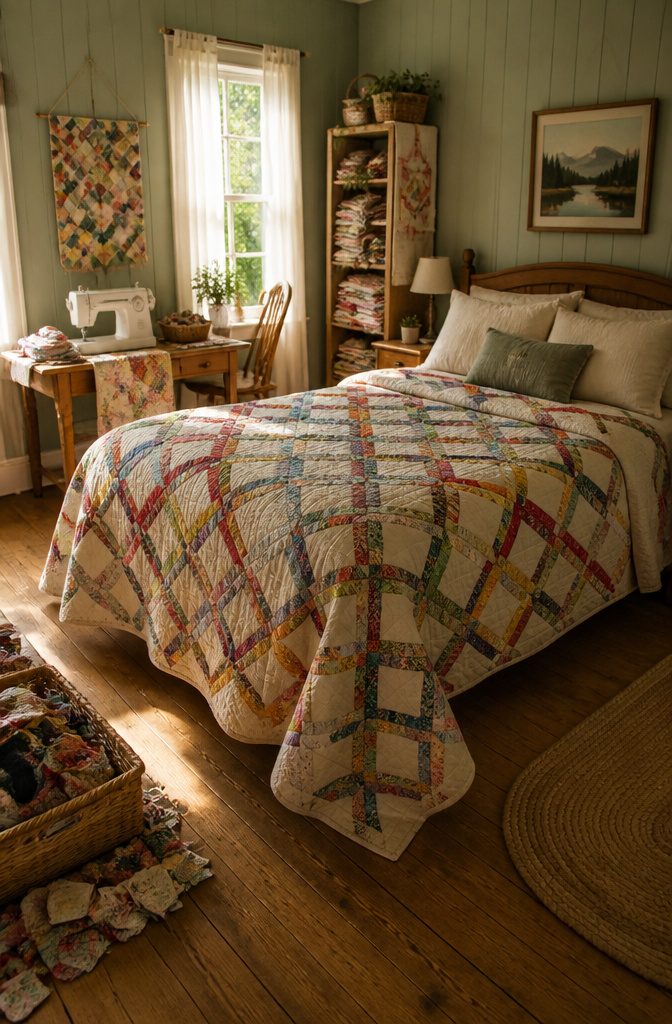
A patchwork quilt is the classic scrap project, and it is also the one that will not fit in an afternoon.
Piecing, layering and quilting a full bed-size top takes days of work. Rainbow lattice patterns look great, though a single color family is easier to pull together from a mixed bin.
For a finish in one sitting, I would start with a table runner.
A scrappy table runner uses the same piecing and quilting steps at a fraction of the size. The one thing you may need to buy is low-loft batting; the fabric is already in your stash.
A mini quilt works the same way and can hang on a wall, and a rag quilt is a forgiving choice if you want something to drape over the couch.
14. Fabric Wreaths
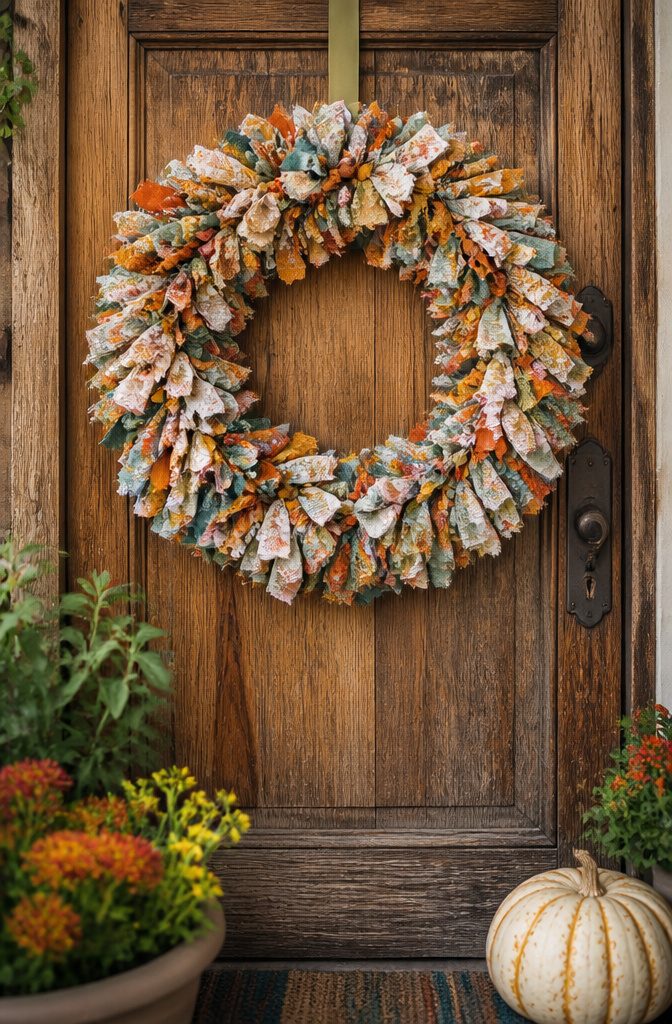
A fabric wreath is one of the few scrap projects that needs no sewing at all. You tie strips onto a ring, one knot at a time, until the form disappears.
A wire or foam ring works, and the strips can be any length you have, though keeping them roughly uniform makes the finished wreath look fuller and tidier.
Seasonal color is where this project pays off.
Orange and black scraps make a Halloween wreath, pastels suit Easter, and red and green cover Christmas. Since the strips just knot on, I’d keep one ring and swap in new scraps each season.
Mix prints with solids. Tie the strips tightly and push them close together on the ring, because loose knots leave gaps that show the form underneath.
15. DIY Hair Accessories
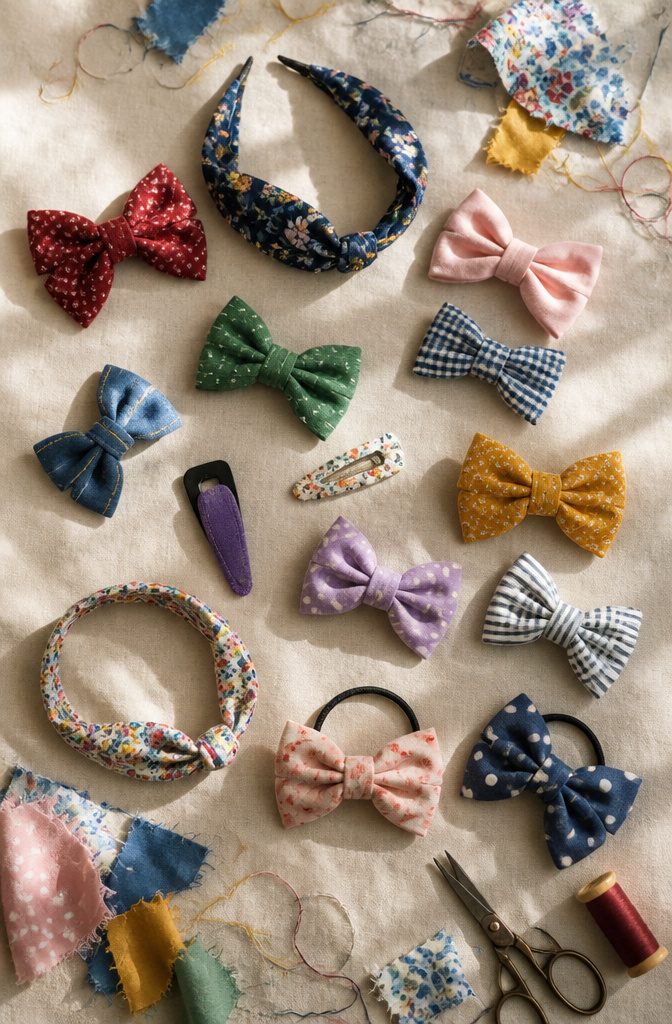
Hair accessories ask for very little fabric, which makes them the fastest way to burn through the smallest pieces in the bin. Bows, headbands and clips all fit in an afternoon, and a single scrap is often enough for one.
Headbands are where I’d start.
An infinity headband is a good pattern for a bad hair day, since the loop does the styling for you. For workouts, add Velcro to the band so it won’t slip, which fixes the usual complaint about fabric headbands.
Bows and clips use even less.
Pick a bold print you’d never buy as yardage, because a small area shows it off without overwhelming an outfit. Mixing prints on one bow also looks intentional rather than leftover.
Sorting Scraps by Size and Color
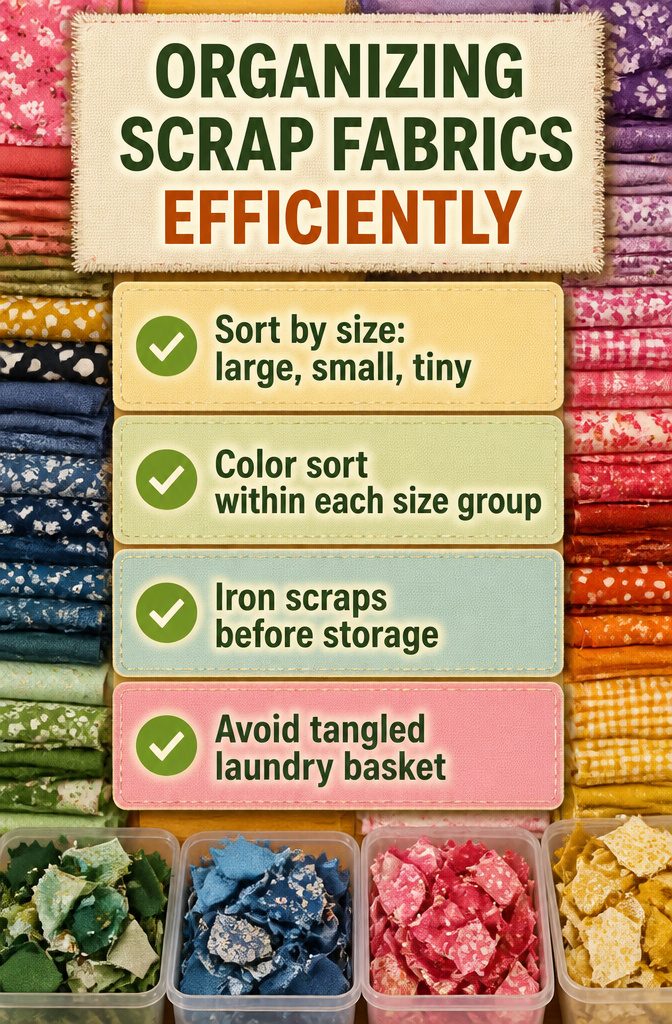
Sort scraps twice, once by size and once by color, and finding the right piece stops being a dig through a pile.
- Split by size first: larger cuts in one group, small pieces in another, and tiny bits in a third. Tiny bits still earn their keep as stuffing or in mosaic-style designs, so save them.
- Sort each size group by color. Pieces for a color-driven project, like a patchwork top, come out in one grab.
- Iron scraps before they go into storage. Folds and creases from a crowded bin throw off cutting, and flat pieces lay out more accurately.
- Skip the laundry basket under the table. It holds a lot, but everything sinks into one tangle and the color sorting is gone in a week.
Why Scraps Are Sustainable
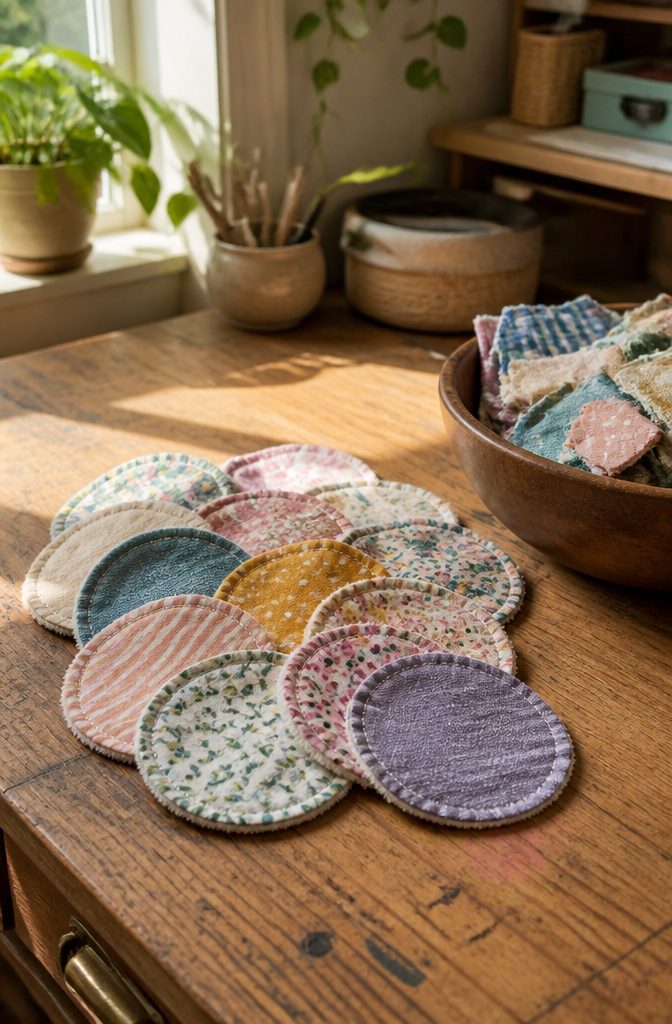
Scraps that are too small to be obviously useful usually end up in the trash, and that is where the waste starts.
Fabric left over from sewing, or rescued from a grandparent’s attic, keeps its value long after the big cuts are gone. Small pieces still carry color, pattern and texture.
The clearest proof is the reusable make-up remover pad.
It replaces disposable cotton pads and cleaning wipes, and it takes just a few scraps and a square or hexagon template. Toss the pads in the machine, or soak them in warm, soapy water and wash by hand.
A pad you wash and reuse keeps a throwaway product out of the bin, which I think is the strongest case for scrap crafting.
Budget matters too. Every scrap you use is fabric you didn’t buy for the next project.
Making New Fabric From Tiny Scraps
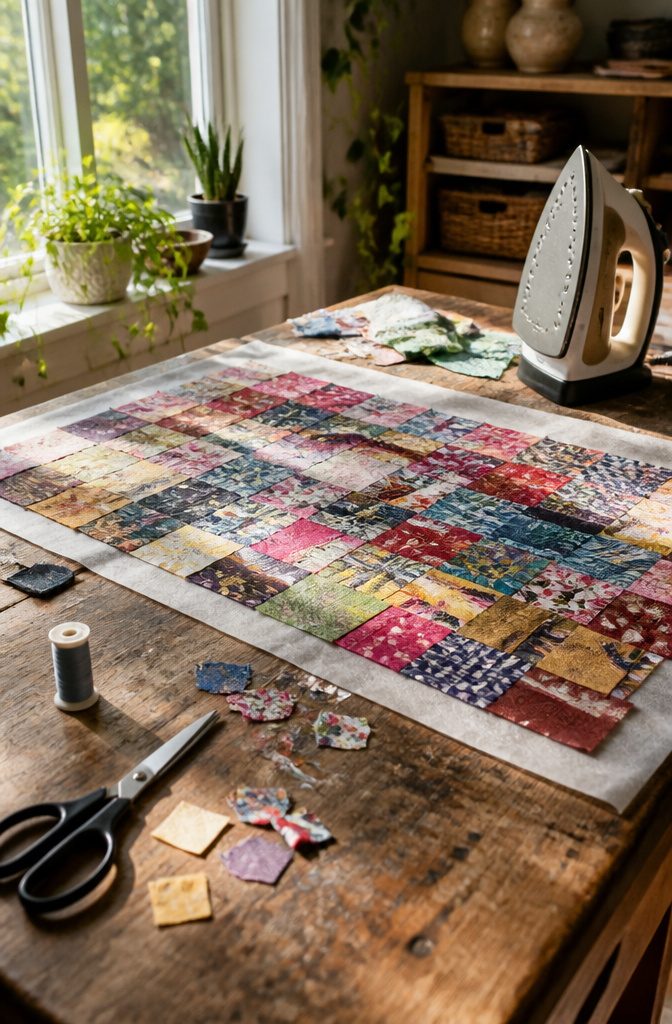
Fusible interfacing turns pieces too small for anything above into a fresh sheet of patchwork cloth. Interfacing is the same thing as iron-on interfacing, and any weight or size works, so your leftover interfacing scraps get used too.
Lay the interfacing bumpy, glue side up, and cover it with fabric bits, overlapping the edges a little.
Leave no gaps, because bare glue sticks to the iron and makes a mess. Press straight down with the iron instead of gliding, which keeps the pieces from shifting.
Overlapped edges won’t bond fully, so stitch over the sheet with your sewing machine to lock them in. Then cut it like any yardage.
Frequently Asked Questions
What can I make with scrap fabric?
Coasters, tote bags, scrunchies, patchwork pillows, bookmarks, bowl cozies, reusable snack bags, bunting, wreaths, hair accessories and eye pillows all work.
Small pieces can also be fused onto interfacing to make a new sheet of patchwork cloth. Pick the project by the size of your scraps: tiny bits suit ornaments and bookmarks, while larger pieces suit totes and pillows.
Are there beginner-friendly scrap fabric crafts?
Yes, coasters and bookmarks are the easiest places to start. A coaster is a square of sturdy cloth with a few straight stitches, or just frayed edges with no sewing at all.
Bookmarks need only a strip barely bigger than your hand, and kids can sew them too. A knotted fabric wreath is another option that skips the sewing machine entirely.
How do I organize my fabric scraps?
Sort them twice, first by size and then by color within each size group. Iron the pieces before storing them so folds and creases don’t throw off your cutting.
Keep tiny bits too, since they work as stuffing or in mosaic-style designs. Avoid tossing everything into one basket, because the colors end up tangled together within a week.
What are some ideas for patchwork projects?
Patchwork pillow covers, scrappy tote bags, table runners, mini quilts and rag quilts are all good choices.
A full bed-size quilt takes days, so a table runner is a better pick if you want to finish in one sitting. For pillows, keep each cover to scraps of similar weight so the seams don’t pucker.
Does Hobby Lobby or Michaels sell fabric scraps?
Neither store is known for selling scraps by the bag, so call your local Hobby Lobby or Michaels and ask whether they keep a remnant bin or sell cut-offs near the cutting counter.
You may not need to buy any: leftovers from past sewing projects, worn shirts, curtain remnants and fat quarters from a fabric pack all work for these crafts.